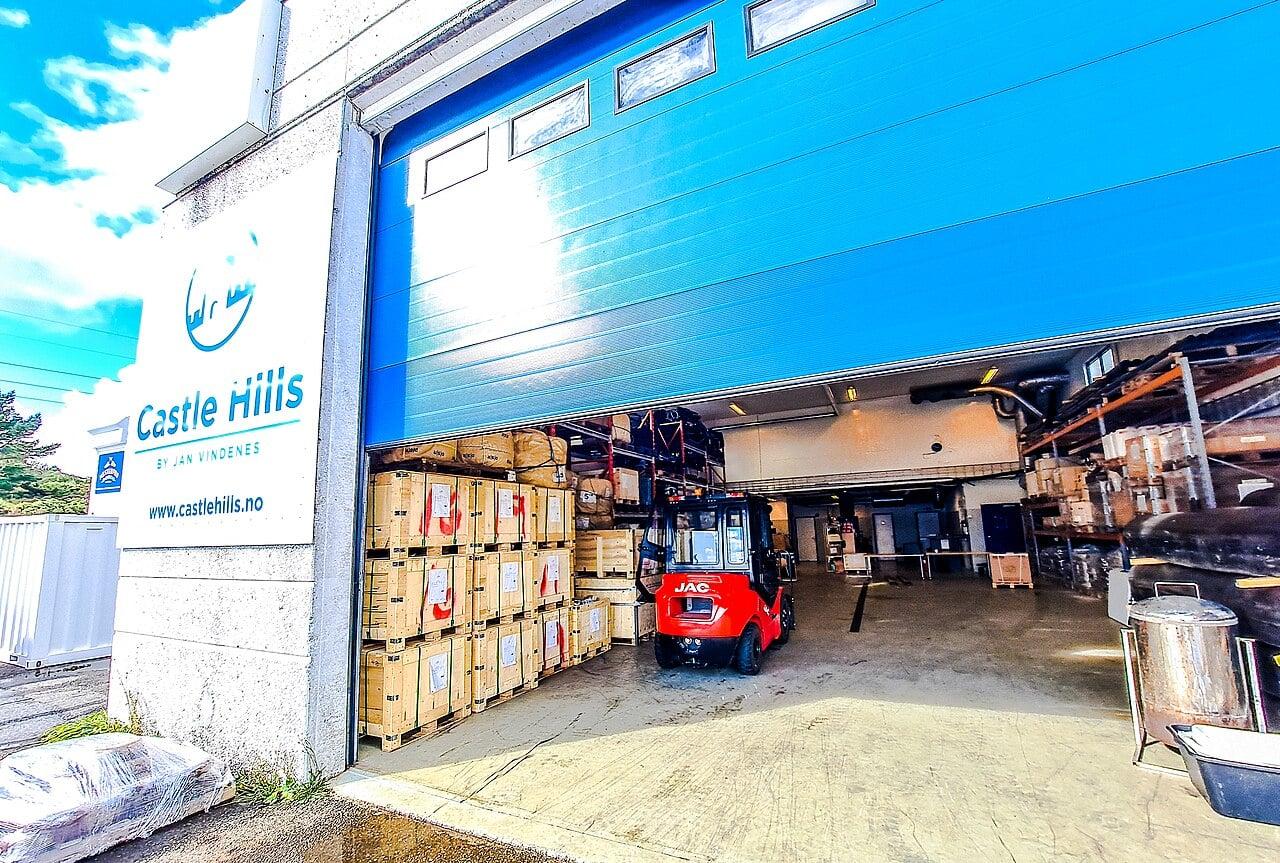
Cold storage doors are purpose-built to seal temperature-controlled environments — walk-in coolers, blast freezers, refrigerated warehouses, and pharmaceutical cold rooms. They are different in construction, hardware, and seal requirements from standard insulated commercial doors. We supply, install, and service cold storage overhead doors across Greater Vancouver. Call 604-206-5727.
What Makes Cold Storage Doors Different
A cold storage overhead door needs insulation in the R-25 to R-40 range for freezer applications, versus R-12 to R-17 for a heated warehouse door. The hardware — springs, hinges, cables — must be rated for continuous cold exposure. Standard rubber seals stiffen and crack below -10°C; cold storage doors use specialty low-temperature vinyl or brush seals that maintain flexibility down to -40°C. Operators on cold storage doors also need low-temperature lubricants and motor specifications that handle cold-start conditions.
Condensation management is the other critical factor. When a cold storage door opens to a warmer ambient environment, moisture condenses on the door surface and in the seal area. Properly specified cold storage doors have a thermal break between inner and outer skins and perimeter seals designed to manage this condensation rather than trap it.
Insulated Panel Construction for Cold Storage
High-performance cold storage panels use polyurethane foam injected between steel skins with a true thermal break at all metal-to-metal connections. The thicker the panel, the higher the R-value — panels range from 2 inches to 4 inches in commercial cold storage applications. For blast freezer environments, double-skin panels with additional foam injection are available.
Cold Storage Service Intervals
Cold storage doors should be inspected at least annually. Seals are the first thing to fail — low-temperature seals still crack and compress over time, and a seal gap in a -20°C freezer room is a measurable energy cost per hour. Operators in cold environments also need low-temperature lubricant applied more frequently than in ambient conditions.
Frequently Asked Questions
What type of door is best for a commercial walk-in freezer?
For a walk-in freezer, a sectional overhead door with polyurethane-core insulated panels at R-25 or higher, low-temperature perimeter seals, and a cold-rated operator is the right configuration. The exact specification depends on your freezer temperature, the ambient temperature of the surrounding space, and how often the door cycles.
Can a standard commercial door be used on a cold storage room?
A standard insulated commercial door at R-12 to R-17 is adequate for a refrigerated cooler (above 0°C). For a freezer environment (below 0°C), standard seals stiffen and fail, and the R-value is insufficient. A cold storage door is the correct specification.
How do I stop condensation on my cold storage door?
Condensation on a cold storage door usually means a thermal bridge somewhere in the door panel or frame — a path of metal connecting the cold and warm sides. Properly specified cold storage doors with a true thermal break significantly reduce this. Anti-condensation heater strips on the door frame are also an option for high-humidity environments.
Do you repair cold storage doors in Vancouver?
Yes. We service cold storage overhead doors across Greater Vancouver and the Lower Mainland. Call 604-206-5727 for service or installation enquiries.
Call us for commercial door service in Vancouver: 604‑206‑5727 — same-day response, 24/7 emergency, honest quotes before any work starts.
Cold Storage Door Types for Different Applications
Not every cold storage application uses the same door type. The right door depends on the operating temperature, the frequency of use, the size of the opening, and whether the priority is maximum insulation or cycle speed.
Sectional overhead doors with high-insulation polyurethane panels are the standard for large cold storage warehouse openings. They are well-suited to openings that see moderate traffic — trucks entering and exiting a few times per shift — where the door is closed between uses and maximum thermal performance matters.
High-speed roll-up cold storage doors are used at internal openings inside a cold storage facility — between a blast freezer anteroom and the main freezer, or between different temperature zones in a multi-zone cold room. These doors prioritize cycle speed and reduce total open time per cycle, which matters at an internal opening that may cycle hundreds of times per day.
Bi-parting high-speed fabric doors are found in large-format pharmaceutical cold rooms and some food processing applications where hygiene and rapid cycle times are both required. They are significantly more expensive than sectional doors but appropriate for high-cycle internal openings where energy loss per open cycle is the dominant cost.
For small walk-in cooler and freezer openings — under 8 feet wide — commercial hinged or sliding cold storage doors are often more appropriate than overhead doors. Overhead sectional doors have a minimum practical width. Below that, a well-sealed cold storage swing door or sliding door is simpler and performs as well.
Temperature Ranges and Specification Requirements
The operating temperature range dictates the door specification at every level. A refrigerated cooler at 2°C to 4°C has different requirements than a blast freezer at -30°C.
For cooler applications (0°C to 10°C): standard insulated sectional panels at R-12 to R-17 with standard rubber seals are adequate. The seals will perform at these temperatures and the panel insulation is sufficient for a mild temperature differential.
For freezer applications (-5°C to -20°C): panels should be R-25 or higher, seals must be low-temperature rated vinyl or brush seals, operators must use cold-temperature lubricant, and the opening frame should have a thermal break to prevent frame condensation.
For blast freezer applications (below -20°C): panels at R-32 to R-40, heavy-duty low-temperature seals rated to -40°C, heater strips on the door frame to prevent ice build-up in the seal area, and operators with motor specifications for cold-start at extreme temperatures. Some blast freezer installations use a vestibule approach — a small heated antechamber between the ambient space and the freezer — rather than relying entirely on the door to manage the temperature differential.
Ice Build-Up and How to Prevent It
Ice formation at the bottom seal and in the seal perimeter is a common problem in freezer door applications. It is caused by moisture from warmer ambient air condensing on the cold door surface and freezing. Left unaddressed, ice build-up prevents the door from sealing fully and can jam the door in the closed position.
Heater strips embedded in or around the door frame keep the frame surface above freezing, preventing moisture from reaching the freeze point before it drains away. Bottom seal heaters are also available for very cold applications.
The other solution is cycle speed — a high-speed door that cycles in under three seconds gives ambient air very little time to reach the freezer interior and condense on the frame. For high-traffic internal freezer openings, a high-speed crash door often solves ice build-up more effectively than heaters on a slow sectional door.
Cold Storage Doors in Vancouver’s Climate
Metro Vancouver’s marine climate creates a specific challenge for cold storage installations. Ambient humidity is high for much of the year — relative humidity in the 80 to 95% range is typical in winter and fall. High ambient humidity means more moisture is available to condense on cold surfaces.
For Vancouver cold storage facilities, this means seal condition is critical. A marginal seal that might perform adequately in a drier climate — Alberta, Saskatchewan — will fail to contain condensation in Vancouver’s humid winters. Seal inspection and replacement should be part of every annual maintenance visit, not a reactive item.
Salt-adjacent facilities in Delta, Richmond along the river, and Marine Drive corridor locations also see accelerated corrosion on hardware. Steel tracks, cable drums, and spring shafts on these buildings need more frequent lubrication and earlier replacement than inland installations.
Food Safety, HACCP, and Cold Storage Door Requirements
Cold storage facilities subject to CFIA inspection or HACCP plans have specific requirements for doors. Common requirements include:
No exposed wood in the door or frame — all materials must be cleanable and non-porous. Sectional steel doors satisfy this requirement. Older walk-in cooler doors with wood frames do not.
Seals must be intact with no gaps — any gap in the perimeter seal is a contamination risk and will fail a HACCP inspection. Annual seal inspection should be documented.
Door surfaces must be cleanable — painted steel panels are cleanable with standard food processing sanitizers, but the finish must be intact. Chipped or peeling paint on a cold storage door in a food storage application is a CFIA issue.
We are familiar with these requirements and can advise on specification for facilities subject to food safety inspection. For facilities seeking to bring an existing installation into compliance, we can assess the current door and provide a scope for what needs to change.
Brands We Install and Service for Cold Storage
For cold storage sectional overhead doors we primarily work with Hörmann’s commercial high-insulation range, which includes their ThermoUp series at R-25+ for freezer applications. Amarr’s commercial thermal break panels are used for refrigerated cooler applications at R-14 to R-17.
For high-speed internal cold storage doors, we work with Rytec and Assa Abloy cold storage high-speed doors. These are specialist products with longer lead times and higher cost than standard commercial doors, but they are the correct specification for high-cycle freezer openings.
Frequently Asked Questions — Cold Storage Doors Vancouver
What R-value do I need for a blast freezer door?
For blast freezer applications below -20°C, target R-32 or higher in the panel, with a heater strip on the frame. Below -25°C, a vestibule approach or a high-speed door may outperform a standard sectional door regardless of panel R-value.
How often do cold storage door seals need to be replaced?
In Vancouver’s humid climate, inspect cold storage seals annually. Low-temperature vinyl seals typically last three to five years before showing compression set. Brush seals in high-traffic freezer openings may need replacement every two to three years. Seals that show any cracking, compression, or gaps should be replaced immediately — the energy loss and contamination risk are not worth deferring.
Can you retrofit a standard commercial door to cold storage spec?
Not practically. A standard commercial door with R-12 panels cannot be upgraded to R-25 cold storage spec — it requires a different panel, different seals, and different hardware. The correct approach for a cold storage upgrade is a full door replacement with the right specification from the start.
How do you prevent ice at the bottom of a freezer door?
A bottom seal heater strip keeps the seal surface above freezing and prevents ice formation. Combined with a tight seal perimeter and a door that closes fully, this eliminates most bottom ice problems. If ice forms despite heaters, the seal itself may need replacement — ice forming under a heater strip usually means the seal has lost its profile and air is bypassing it.
Call us for cold storage door installation and service in Vancouver: 604-206-5727 — proper specification, right installation, annual maintenance.