Condensation on a commercial overhead door is not a door problem. It is a building problem that shows up on the door first. The steel skin is the coldest surface in the room. When warm, moist air hits it, water forms. That is the whole story — but the fix depends on which side of the dew point you can control.
Why the door sweats
Steel conducts heat fast. An uninsulated 24-gauge skin drops to within a degree or two of the outside temperature. Inside a warehouse kept at 18 °C with 60 % relative humidity, the dew point sits around 10 °C. Any night the outdoor temperature falls below that, the door becomes a dehumidifier. A 16 × 14 foot panel can pull litres of water out of the air overnight.
Insulated doors slow the process. They do not stop it. A polyurethane core rated R-12 still has thermal bridges at the stile ends, the bottom seal, and every hinge point. If the interior vapour barrier is punctured — and it almost always is, by track bolts, operator brackets, or forklift impacts — moist air reaches the cold steel from the back side too. That is why you see rust blooming around hardware before the panel faces show a spot.
Where the moisture actually comes from
Loading docks are the worst offenders. Every time a trailer pulls away, the dock seal leaks a slug of outside air. In a Lower Mainland winter that air is cool but saturated. In summer it is hot and saturated. Either way, the absolute humidity inside the building climbs. Add a wash bay, a food processing line, or simply a crew of 20 people breathing in an unventilated space, and the vapour load doubles.
Strata parkades behave differently. The moisture comes from vehicles. A wet car carries 5–10 litres of water into the parkade. Multiply by 80 stalls. The ventilation fans run on timers or CO₂ sensors, not humidity. The door at the ramp entrance sees the full swing: cold slab, wet tires, warm exhaust, then the door cycles open and the cycle repeats.
Reading the pattern
Water running down the face of the panels — especially the bottom three sections — means the interior air is the source. The door is just the radiator.
Water dripping from the header or pooling on the operator motor points to infiltration from above. Roof drains blocked, parapet flashing failed, or the door head jamb was never sealed to the structure. That water is not condensation. It is a leak that mimics condensation.
Rust on the bottom roller brackets and cable drums while the panel faces stay clean tells you the concrete slab is wicking moisture upward. The door sits in a damp zone 24/7. No amount of interior ventilation fixes a wet slab.
Ventilation moves the line
You lower the dew point by removing vapour, not by adding heat. A 5 kW unit heater aimed at the door raises the steel temperature a few degrees — enough to stop visible dripping on a marginal night — but it does nothing to the vapour pressure. The moisture stays in the building. It migrates to the next cold surface: roof deck, sprinkler pipes, electrical panels.
Exhaust fans sized for air changes per hour (ACH) are the standard fix. For a 20,000 sq ft warehouse with dock traffic, 1.5 ACH is a starting point. That means a 5,000 CFM fan running continuously during occupied hours. Interlock it with the dock doors so it ramps up when a door opens. If the building has make-up air, heat it. Cold make-up air in January drops the interior temperature, which drops the dew point, which looks like progress until you realize the heater is now fighting the fan.
Dehumidifiers work in smaller, sealed spaces — a freezer vestibule, a clean room anteroom, a server room with a personnel door. They are pointless on a 40-foot dock door that cycles 30 times a day.
Insulation upgrades: what changes, what doesn’t
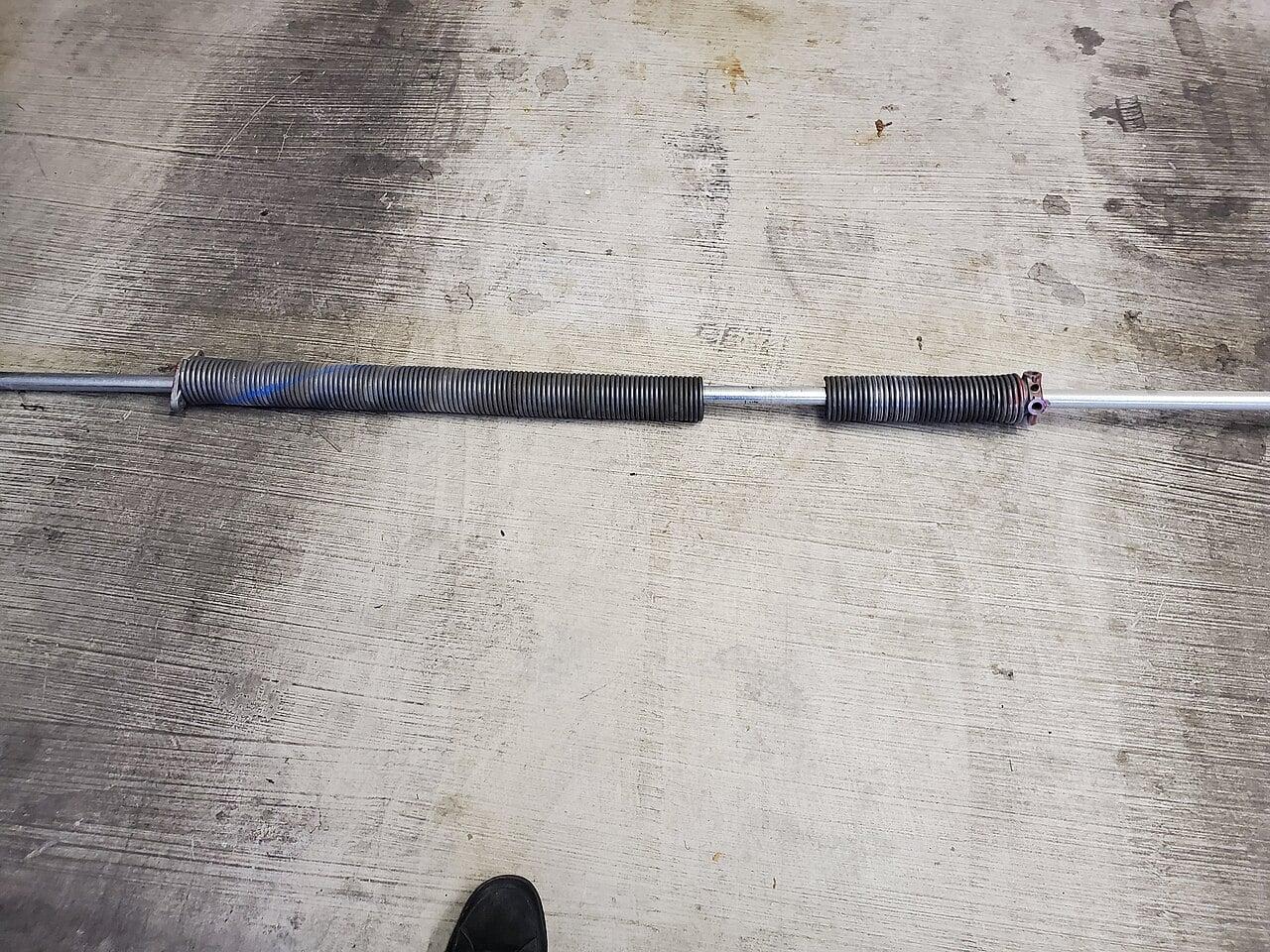
Retrofitting polystyrene sheets into hollow panels raises the interior surface temperature by 3–5 °C. That buys you a wider safety margin on cool nights. It also adds 1.5–2 lb/sq ft. On a 14-foot wide door, that is 200+ lb. The spring counterbalance must be recalculated. If the springs are already at the top of their cycle range, the door will not stay open. The operator will fault on overcurrent. The cables will slack on the drums.
Factory-insulated sections (Amarr 2742, Raynor Aspen, Hörmann 42) use a continuous foam core with thermal breaks at the stile ends. They perform better than any retrofit. But they cost three times what uninsulated sections cost, and the lead time is six to eight weeks. If the door is 15 years old, replace the whole assembly. Hanging new insulated sections on old track, worn rollers, and a sagging header is a waste of money.
Vapour barrier continuity
The most overlooked fix costs nothing in materials. Seal every penetration on the interior face of the door. Track bolts: dab of polyurethane sealant on the bolt head before the nut goes on. Hinge screws: same. Operator bracket lag bolts: same. Bottom seal retainer: run a bead along the full width before you snap the vinyl in. Jamb weatherstripping: caulk the flange to the wall, not just the door edge.
This does not stop conduction. It stops the convective loop where interior air circulates through the door cavity, hits the cold skin, condenses, and rains back into the building. A 16-foot door with 200 penetration points moves a surprising volume of air through that loop.
Drain the bottom
Every commercial door should have weep holes in the bottom seal retainer — two per section, 12 inches from each end. Factory sections often ship without them drilled. Drill them. 3/16 inch, angled down. Water that gets past the seal (and water will get past the seal) exits instead of pooling against the bottom stile. A pooled bottom stile rots from the inside out. You won’t see it until the section buckles.
If the slab slopes toward the door, cut a shallow trench drain in front of the opening. 4-inch PVC, grate top, tied to storm. Cheaper than replacing a door section.
When to call
You have sealed penetrations, added exhaust, confirmed the weep holes flow, and the door still drips every morning. The door is the wrong tool for the environment. A freezer door in a cooler opening. An uninsulated door in a heated wash bay. A sectional where a high-speed roll-up with an air curtain belongs.
That is a specification problem, not a maintenance problem. We can walk the opening, measure the delta-T, log the humidity for a week, and tell you what door actually fits the condition. No guesswork.
Call (604) 206-5727 — Metro Vancouver.