A cycle rating tells you how many open-and-close cycles a torsion spring is engineered to survive before metal fatigue causes it to snap. One cycle equals one full open and one full close. A 10,000-cycle spring on a door that runs 20 times a day lasts about 16 months. The same door on a 50,000-cycle spring runs for six and a half years. The door, the opener, the track — none of it changes. Only the spring wire diameter and length change.
Most spec sheets list four standard ratings: 10k, 25k, 50k, and 100k. The numbers look like a good-better-best menu. They are not. They are a calculation of wire size, spring length, and the physical space inside your header.
Why the rating changes the spring, not just the price
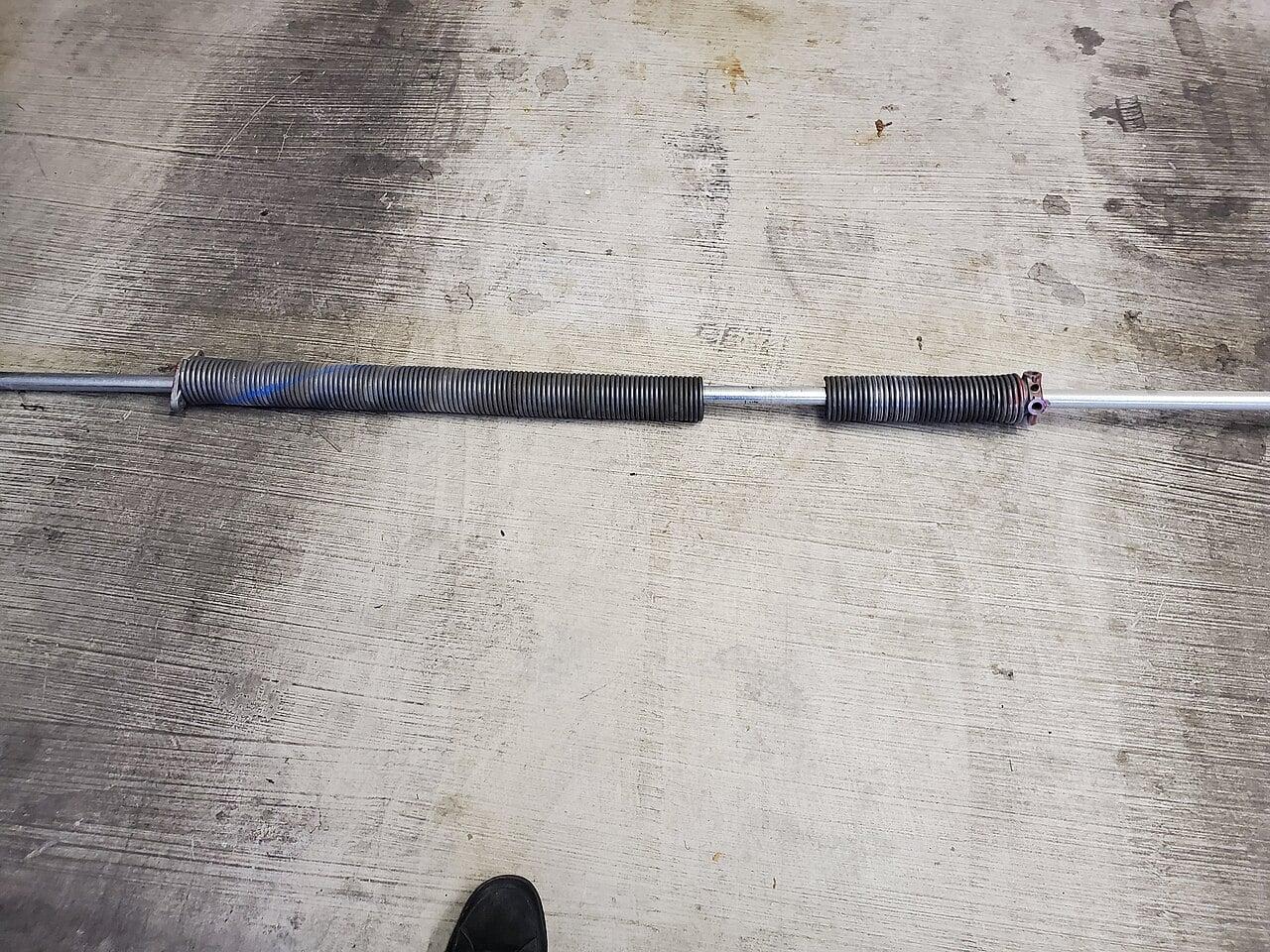
To get more cycles, the spring wire must be thicker and the spring body longer. Thicker wire reduces stress per cycle. Longer length spreads that stress over more coils. A 10,000-cycle spring on a 14-foot door might be 34 inches long with .250-inch wire. The 50,000-cycle version for the same door grows to 48 inches and .306-inch wire. The 100k version pushes past 60 inches.
That extra length has to fit in the headroom above the door. If your header only gives you 16 inches of clearance, a 100k spring simply will not fit. You cannot “upgrade” past the space you have. This is the constraint that decides the rating for you before you ever look at a price list.
Matching cycles to actual traffic
Count the cycles. Do not guess.
A warehouse with two shifts, three dock doors, and 15 forklift entries per door per shift runs 90 cycles a day per door. That is 32,850 cycles a year. A 25k spring fails before month ten. A 50k spring gives you 18 months. A 100k spring buys three years.
A strata parkade with 80 units sees maybe 160 cycles a day total — 58,400 a year. A 50k spring lasts ten months. A 100k spring lasts 20 months. The math is unforgiving.
If you do not know your daily count, put a cycle counter on the operator for two weeks. LiftMaster and Manaras commercial boards log this natively. Most facility managers are off by a factor of three when they estimate.
The hidden cost of undersizing
When a spring fails on a 16-foot sectional, the door drops. If it is mid-cycle, the bottom section hits the floor with the full weight of the door — 400 to 600 pounds on a standard commercial sectional. The bottom seal crushes. The bottom panel buckles. The cable drums can shatter. The operator carriage rips off the trolley.
You are not replacing a spring anymore. You are replacing a bottom section, possibly a full panel set, cables, drums, and operator parts. The labour is four hours instead of one. The downtime is a full shift instead of a lunch break.
A 50k spring costs roughly 40 percent more than a 10k spring. The emergency replacement of a crashed door costs ten times that.
When 10k is the right call
Low-cycle doors exist. A fire-rated door that only opens for annual testing and the occasional pallet delivery might see 50 cycles a year. A 10k spring lasts 200 years on paper. Corrosion will kill it first. In that case, the thinner 10k wire fits tighter headroom, costs less, and leaves budget for a proper corrosion-resistant coating or a maintenance contract that catches the rust before it pits the wire.
Seasonal operations — cold storage that only runs three months a year, agricultural buildings active only at harvest — can also justify 10k or 25k if the headroom is tight and the annual count stays under 5,000.
High-lift and vertical-lift doors change the math
A standard-lift door raises the spring tension gradually as the door rises. A high-lift or vertical-lift door carries full spring tension the moment the door clears the header. The spring works harder per cycle. A 25k spring on a vertical-lift door behaves like a 15k spring on standard lift. If your doors are high-lift, step up one rating tier from what the traffic math suggests.
Dual-spring systems and cycle life
Two springs share the load. Each spring sees half the torque. In theory, that doubles cycle life. In practice, it does not. When one spring breaks, the other instantly carries the full load — often at the worst point in the travel. The second spring fails within weeks. Always replace both. Spec the pair for the full door weight at your target cycle rating. Do not spec each spring for half the cycles.
What to tell your installer
Give them three numbers: door weight, daily cycle count, and headroom clearance in inches. If you have high-lift or vertical-lift track, say so. If the door is insulated, say so — insulation adds 30 to 50 percent to the weight.
Ask them to show you the spring calculation sheet. Any commercial shop running the DASMA or manufacturer software can print it. It lists wire size, inside diameter, length, and rated cycles. If they cannot produce it, they are guessing.
The coating question
Galvanized wire is standard. Powder-coated or epoxy-coated wire adds corrosion resistance in wash-down environments — food plants, chemical facilities, parkades with road salt. The coating does not increase cycle rating. It prevents the rust pits that become stress risers and cut the actual life in half. In a dry warehouse, bare galvanized is fine. In a parkade, pay for the coating.
One number to remember
Divide your rated cycles by your actual annual cycles. If the answer is under 1.5, you are buying a spring replacement every year. If it is over 3, you are replacing springs on a planned maintenance schedule instead of an emergency call. That is the only metric that matters.
Call (604) 206-5727 — Metro Vancouver.