Sooner or later a fire consultant, an inspector or an alarm contractor asks: is that overhead door tied into the fire alarm? The answer depends on what the door is, what the code needs it to do, and what its operator can actually accept. Here's how those three fit together, with the code text and what the operator manuals do and don't say.
“Tie the door into the fire panel” sounds like one wire. In practice it’s a design question with three parts. Is the door a closure in a fire separation? If it is, what has to happen on alarm? And can the door’s equipment do that in a way the code accepts? An overhead door fire alarm interface that skips the first question often ends up as a standard operator wired to a relay. That may not satisfy anyone.
Step one: is the door a closure in a fire separation?
The building code uses the word “closure” for anything that closes an opening through a fire separation. The Vancouver Building By-law defines it as: “a device or assembly for closing an opening through a fire separation or an exterior wall, such as a door, a shutter, a damper, wired glass or glass block, and includes all components such as hardware, closing devices, frames and anchors.”
If your overhead door sits in a rated fire separation (between a warehouse and an office block, for example, or between two tenancies), it’s a closure. It then has to be a fire-rated assembly. BC Building Code Article 3.1.8.5(2) says closures in required fire separations are installed in conformance with NFPA 80. That usually means a rolling fire door or a listed fire-rated sectional door with its own release equipment. See our rolling fire doors page.
If the door is an exterior loading door or a parkade entry that isn’t part of a fire separation, the hold-open rules below don’t apply to it in the same way. Whether to link it to the alarm at all is then a design decision for the building’s fire consultant.
What the code says must happen on alarm
For closures in fire separations, BC Building Code Article 3.1.8.13 requires doors in fire separations to have self-closing devices, with a few listed exceptions. Doors that are normally held open use hold-open devices under Article 3.1.8.14. Where the building has a fire alarm system, Sentence (2) says the hold-open shall release:
- “in a single-stage system, upon any signal from the fire alarm system”, and
- in a 2-stage system, “upon any alert signal from the fire alarm system, or upon actuation of any adjacent smoke detectors.”
Sentence (3) adds a smoke-detector release (detector connected to the fire alarm and located per CAN/ULC-S524) for certain closures, including exit doors, doors opening into a public corridor and doors that are part of a smoke control system. Sentence (5) allows a heat-actuated release, such as a fusible link, for closures not covered by Sentences (3) and (4).
In buildings without a fire alarm
Sentence (4) covers that case: for the closures listed in (3)(a) to (e), the hold-open releases on a signal from a smoke alarm on each side of the fire separation, at ceiling level, within 1.5 m of the opening.
These articles are the same in the National Building Code 2020 and the BC Building Code 2024. Inside the City of Vancouver, the Vancouver Building By-law applies instead. Check the matching clause there.
What standard commercial door operators can accept
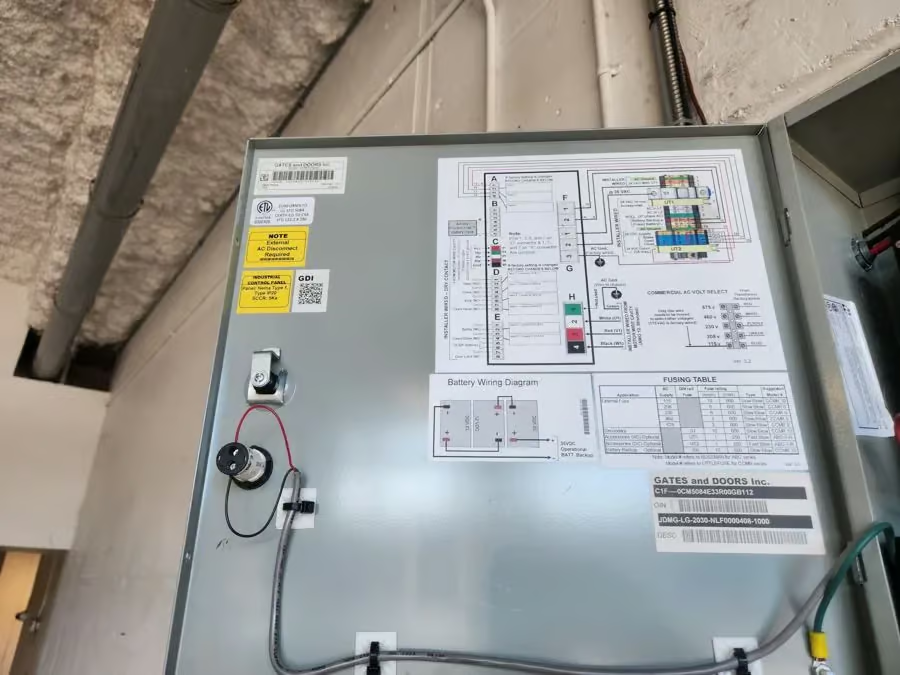
This is the part that’s easy to get wrong. We read the installation manuals for LiftMaster’s Logic 5.0 and MAXUM DC operators looking for a fire alarm input. Neither manual has a fire-alarm terminal or mentions fire doors. What they have is an external interlock:
- Logic 5.0: “External interlocks may be used with all functional modes.” If the interlock opens, the operator won’t run.
- MAXUM DC: “Motor drive circuit is disabled when the INTR LOCK circuit is open.”
An interlock stops the operator. It doesn’t close the door. Manaras’s BOARD 070 sheet lists “external interlocks” among its terminal inputs too, and no fire-alarm function. A relay from the fire panel into one of these inputs can stop a standard operator or command it through its normal controls. That’s not the same thing as a listed fire door release. Don’t assume it satisfies Article 3.1.8.14 or the fire door’s listing. A rated door’s closing method comes from its own listing and NFPA 80 installation, not from the operator.
Where alarm interfaces do make sense on non-rated doors
Some buildings want a non-rated door to do something on alarm. One example is a door that shouldn’t be opened while the alarm is active. Others want it left in a known position for firefighters. That’s a design decision for the fire consultant and alarm designer. The door contractor’s job is to tell them what the operator can and can’t do, in writing.
Testing an overhead door fire alarm interface
Once a door is connected to the alarm, testing involves more than the door company. The standards are CAN/ULC-S536 and CAN/ULC-S1001:
- The alarm system is inspected and tested to CAN/ULC-S536 (NFC 2020 Article 6.3.1.2, unchanged in the BC Fire Code 2024).
- The interconnections are covered by NFC Article 6.8.1.1: “Interconnections between fire protection and life safety systems shall be tested and maintained in conformance with CAN/ULC-S1001, ‘Standard for Integrated Systems Testing of Fire Protection and Life Safety Systems.'”
The explanatory note to 6.8.1.1 lists “door hold-open devices” and “smoke and fire shutters” among the systems whose interconnections owners must confirm are “functioning according to the intent of their design.” It also refers to an Integrated Testing Coordinator, who can accept documented evidence of earlier tests.
Who does what on test day
| Role | Typical job on an overhead door fire alarm interface |
|---|---|
| Fire alarm contractor | Puts the panel in alarm and verifies the output to the door |
| Door technician | Confirms the door does what the design says, resets the door’s release and checks it closes fully |
| Integrated testing coordinator (where S1001 applies) | Plans the sequence and documents the result |
| Building owner or manager | Keeps the records with the fire safety plan |
A rolling fire door also gets its own drop test and monthly operation. See our drop testing guide and fire door testing reference.
Questions to settle before anyone pulls wire
- Is this opening in a rated fire separation? Check the drawings or ask the fire consultant.
- If yes, is the door a listed fire-rated assembly with its own release device? If it isn’t, the interface isn’t the first problem.
- What must the door do on alarm, and on which signal (single-stage, alert, smoke detector)?
- What input on the door equipment receives the signal, and is that method part of the door’s listing?
- How will the door be reset after a test, and by whom?
- Who coordinates the integrated test and keeps the records?
If you’re planning new work, our operator installation planning guide covers the wider checklist. If you want the door side reviewed, bring us in before the panel is programmed, not after.
This article summarizes code text as published by the NRC and the Province of BC. It isn’t a design. The fire consultant and the authority having jurisdiction decide what your building needs.
Fire alarm interface questions
Does every overhead door need to be tied into the fire alarm?
No. The hold-open release rules in BC Building Code Article 3.1.8.14 apply to closures in fire separations. An exterior or parkade door that is not part of a fire separation is a design decision for the fire consultant.
When must a hold-open device release on alarm?
Where the building has a fire alarm system, Article 3.1.8.14(2) says it releases upon any signal in a single-stage system, and upon any alert signal or actuation of any adjacent smoke detectors in a 2-stage system.
Can I wire the fire panel into a standard LiftMaster operator?
The Logic 5.0 and MAXUM DC manuals have no fire-alarm input. They have an external interlock, which disables the operator when opened. That stops the operator. It does not close the door, and it is not a listed fire door release.
What is CAN/ULC-S1001?
It is the Standard for Integrated Systems Testing of Fire Protection and Life Safety Systems. NFC 2020 Article 6.8.1.1 requires interconnections between fire protection and life safety systems to be tested and maintained in conformance with it.
Who tests a door connected to the fire alarm?
Usually the fire alarm contractor triggers the alarm and the door technician confirms and resets the door. Where CAN/ULC-S1001 applies, an integrated testing coordinator plans and documents the test.
Plan the door side of the job
Call (604) 206-5727 or use the contact page. We answer around the clock for commercial door failures across Metro Vancouver.
New commercial clients: 10% off labour on your first service call or repair — mention NEW10 when booking (one per business, not combinable with maintenance-contract pricing, work booked by Dec 31, 2026).