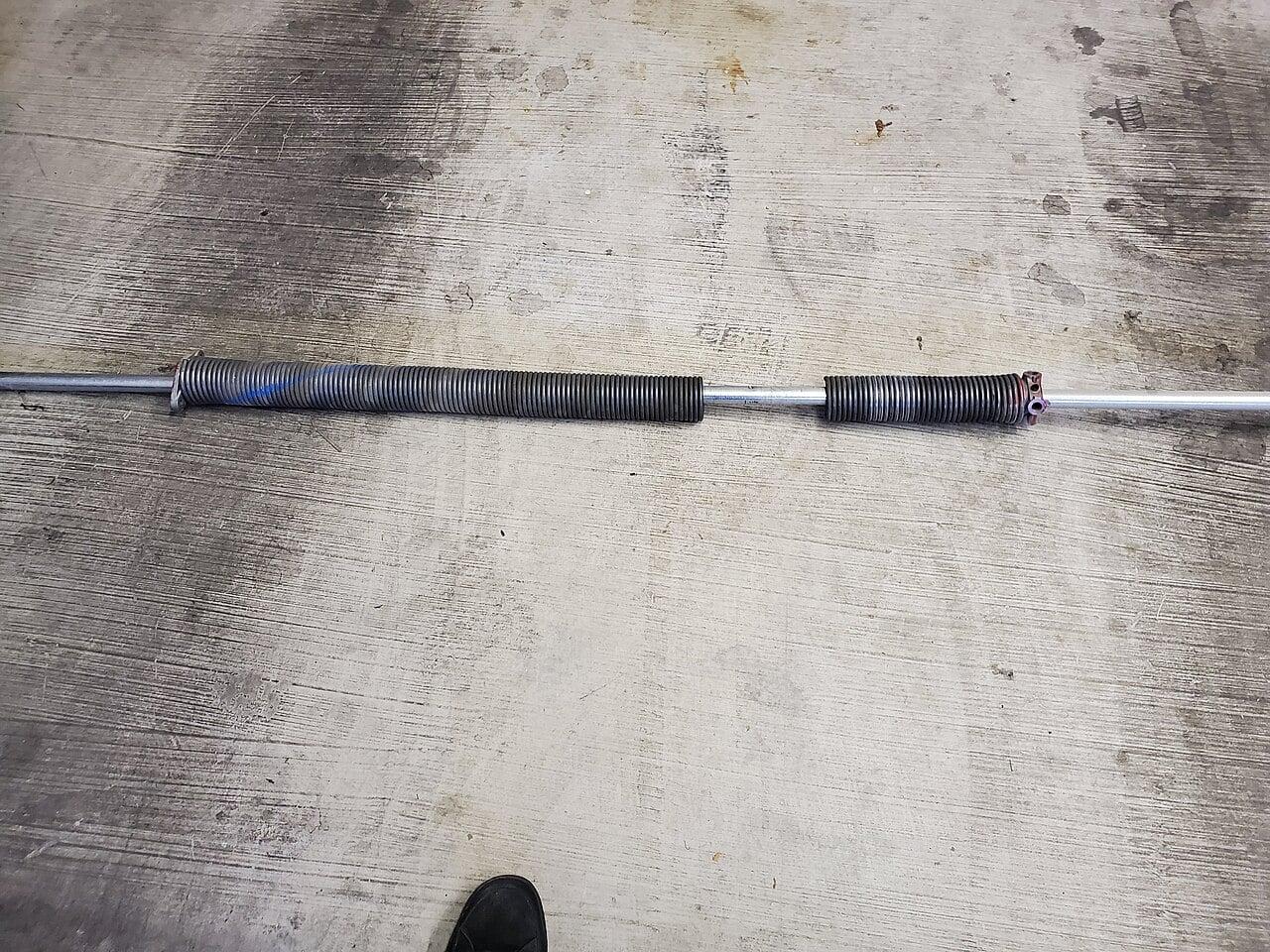
Short answer. A rolling steel door's barrel spring assembly is the pipe above the opening that the curtain wraps onto, with the torsion springs inside it. Amarr marks each barrel with the job number and the adjust side. It also marks the lift point and the number of turns for the door open and closed. Amarr's manual says more turns than recommended shortens spring life and can cause failure. DASMA says only a trained tech should touch the tension wheel, with a properly sized steel bar.
The barrel spring assembly is the whole reason a rolling steel door can be lifted by a chain hoist or a modest operator. On an Amarr 4000 or 4100 series slat door, the curtain wraps around a steel barrel. Inside that barrel are the torsion springs. One end of the springs turns with the barrel, the other end is held by an inner shaft that runs out to the adjusting wheel at the bracket.
This page covers what's in the barrel and how a crew reads it. It does not cover adjusting it. DASMA Technical Data Sheet 284 says the industry strongly advises that only a trained door systems technician should work on a rolling door counterbalance, including any use of a winding bar. We agree, and we'd add that a rolling door barrel can't be inspected from the floor. You won't see a cracked spring inside a pipe.
Barrel spring assembly markings
Amarr's installation manual shows the factory markings on the barrel. There's a job number and an operator end arrow. There's a lift point and an adjust side label too. Most useful of all is the number of turns with the door opened and closed. The manual tells installers to check that the required turns are written on the barrel before it goes up.
That stencil is gold on a repair. If it's still readable, we know what the factory designed the spring for. If the barrel has been painted over or the job sheets are long gone, we work it out from the curtain and barrel size. Take a photo of the markings the next time a lift is up there. It costs nothing.
Rings and how the curtain fastens
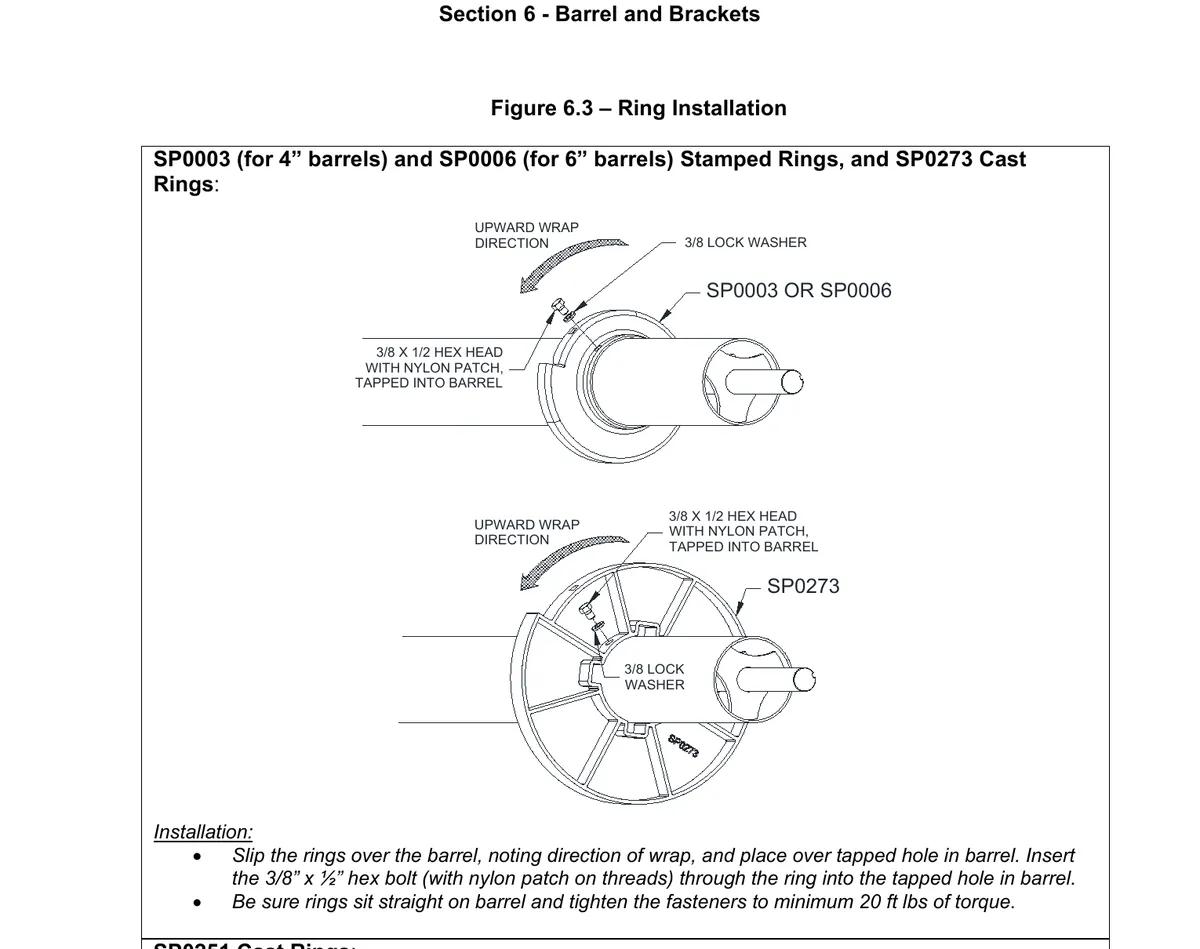
Amarr fastens the curtain to the barrel with rings or tapped holes, depending on the job. Their manual lists SP0003 stamped rings for 4 inch barrels, SP0006 stamped rings for 6 inch barrels and SP0273 cast rings, and notes many larger 8, 10 and 12 inch barrels use tapped holes instead. Rings have to sit straight and face the right wrap direction.
The adjusting wheel and its bar
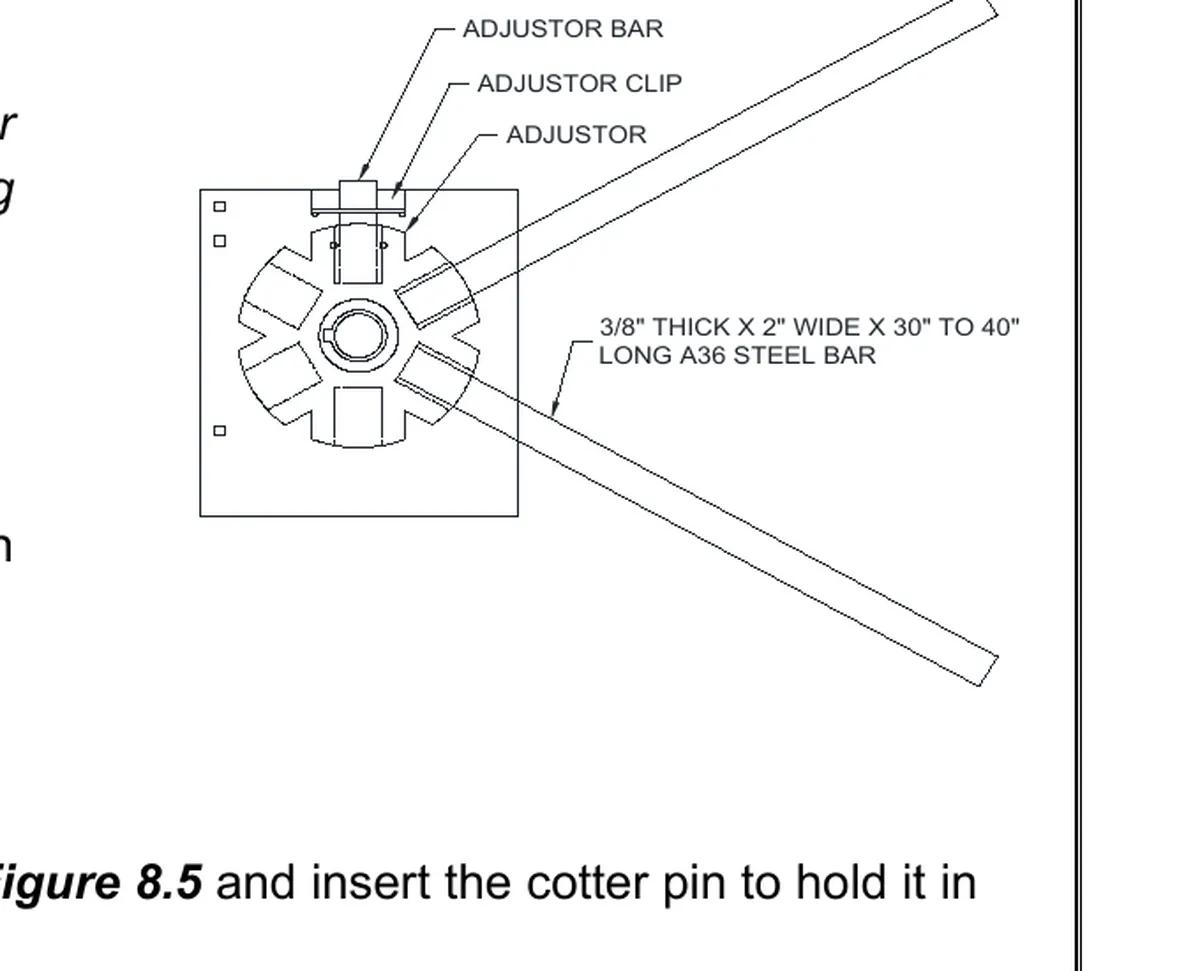
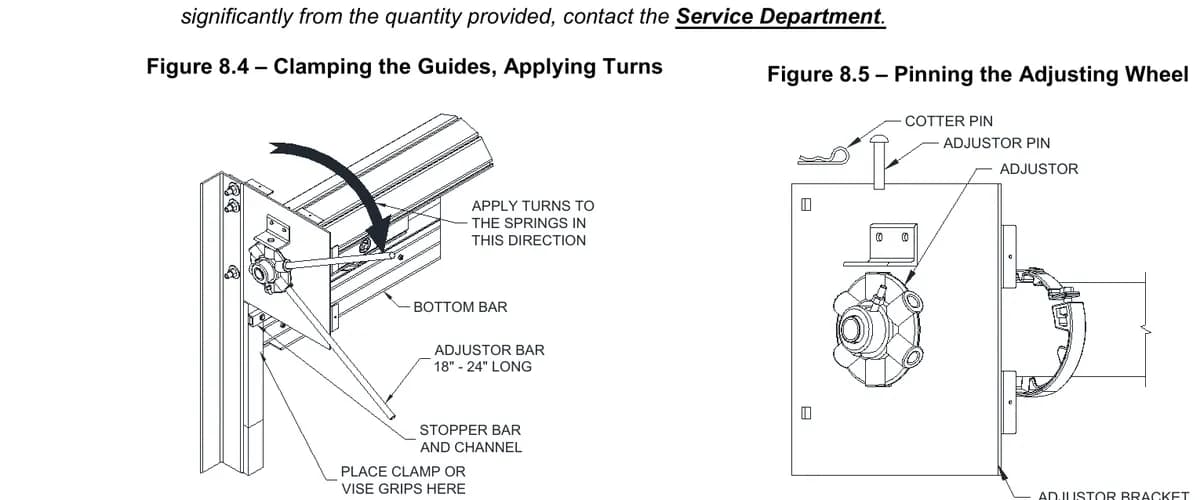
The adjusting wheel, also called the tension or charge wheel, sits on the end of the inner shaft at the bracket. A stop pin and cotter lock it to the bracket. Amarr's SA0005 adjustor is shown with an adjustor bar as a stop and a 3/8 by 2 inch by 30 to 40 inch A36 steel bar.
DASMA 284 adds three points. Tensioning systems are designed so the force can be controlled, but on some doors it is still large. The bar must fit the wheel's pockets and be long enough to control the force. Rebar isn't recommended unless the maker says so. And where the wheel sits matters. A wheel on the outside of the headplate gets its initial tension with the door open. An inside wheel gets it with the door closed.
Turns, and why more is worse
Amarr's manual puts it in a boxed notice. Applying more turns than recommended will reduce spring life and can cause failure, so don't exceed the turns on the barrel or the job sheet. Final tension is trimmed at the curtain once the door is up.
That warning is the opinion we push hardest on this door type. When a rolling door feels heavy, somebody always wants to add a turn. Usually the real cause is a tired spring, a curtain dragging in a bent guide or a dry bearing. Extra turns on a fatigued spring move the break date closer. Our rolling steel door spring tension page explains why a rolling door never balances perfectly, using DASMA's own charts.
Springless barrels
Not every rolling door uses springs. Amarr's parts checklist names an adjusting wheel if the barrel has springs, and an inertia brake typically on units with springless barrel assemblies. If your door has a brake on the barrel and no wheel, the operator is carrying the full curtain and a different set of checks applies.
When to call
Call us at (604) 206-5727 if the tension wheel moves while the door runs, if the door won't stay at the stops, or if a chain hoist suddenly needs two people. For the rest of our rolling door and spring work, see commercial spring repair and the rolling sheet door spring tensioner guide. The spring anchor brackets page and cycle ratings explained round it out.