Facility staff often call us because a rolling steel door "feels heavy in the middle" or "wants to drift up at the top." Sometimes that is a spring problem. Often it is just how a rolling door is built. Here is how to tell the difference, using the door industry's own technical sheets.
A rolling steel door (also called a roll-up or coiling door) works nothing like the sectional doors on most loading docks. The curtain of interlocking slats winds onto a barrel above the opening, and torsion springs inside that barrel offset the curtain’s weight. How much they offset is set by how much tension the springs carry. Get that tension badly wrong and the door slams, creeps, or wears out its operator. Get it right and the door can still feel uneven at points in its travel. That surprises a lot of people.
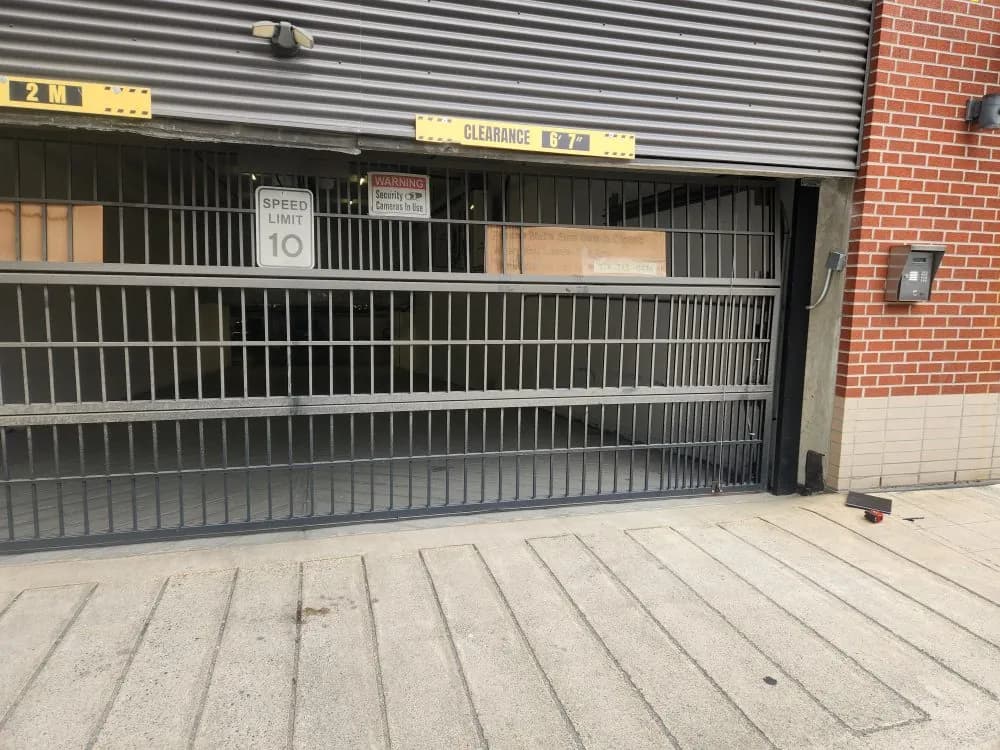
Why rolling steel door spring tension never balances perfectly
The Door & Access Systems Manufacturers Association (DASMA) covers this in Technical Data Sheet #272, Rolling Door Counterbalancing. It opens by saying that counterbalancing a rolling door curtain is different from counterbalancing a sectional door, and that a rolling door will typically be out of balance during some portion of its travel.
The reason is geometry:
- As the curtain rolls up on itself, the coil gets bigger with every turn. So the weight still hanging (curtain plus bottom bar) drops by a different amount with each revolution.
- That makes the door’s torque non-linear: it rises and falls at a changing rate.
- The spring’s torque is typically linear: it changes at a steady rate.
DASMA’s point is that if you plot those two lines on one graph, a door will in most cases balance in only two places, where the lines cross. Everywhere else it is a little heavy or a little light. TDS #272 calls this part of the normal design function of a spring-balanced rolling door, and says that tensioning to a particular degree of balance is a matter of preference.
What “initial turns” do, in DASMA’s example
The spring is pre-loaded with a number of initial turns when the door is set up. TDS #272 shows a hypothetical door at three settings. The numbers belong to that example door, not yours, but the pattern carries over:
| DASMA example | Where the door is closest to balanced | What the operator or user feels |
|---|---|---|
| Case 1: 1¾ initial turns | Fully open and fully closed | More effort to open through most of the travel |
| Case 2: 2 initial turns | Equally close throughout travel | Same effort to close as to open |
| Case 3: 2¼ initial turns | About halfway open | More effort to close from open and near the closed position |
A quarter turn either way moves where the door feels heaviest. That’s why we set rolling steel door spring tension against how the door is actually used. A manual chain door that staff open by hand all day is set up differently from a motor-driven door where the operator does the work.
How much effort is too much?
“Feels heavy” isn’t a measurement. DASMA’s companion sheet for building maintenance supervisors, TDS #270, gives you numbers:
- Force to open should not exceed 35 lb on a hand chain or 25 lb on a crank.
- Big departures from those values may point to a counterbalance problem that needs a trained door systems technician.
- Effort to lift will increase as the door approaches half open. The sheet refers you to TDS #272 for why, so a heavier middle on its own is expected.
For motor-operated doors, TDS #270 suggests a quarterly check: close the door with the operator, switch to manual operation and try to raise it 1 to 2 feet. If that takes excessive force, call for service. Our guide to using a commercial door chain hoist explains how to engage manual operation safely on operators that have one.
Signs the tension really is off
Based on the TDS #270 checklist, these point to a real problem rather than normal uneven feel:
- Hand-chain or crank effort well above the 35 lb or 25 lb guide.
- The tension wheel (charge wheel) or tension shaft moving while the door runs. DASMA says both should stay still.
- In the closed position, the door doesn’t rest on the floor or rise slightly. When opening, it doesn’t advance toward the curtain stops (from TDS #269).
- An operator that strains, trips its overload or swings on its mount. DASMA says the operator should not sway.
Why staff should never “add a turn”
Every DASMA rolling door sheet carries the same warning: the counterbalance assembly is under extreme spring tension at all times, and only a trained door systems technician with proper tools should adjust or repair it. TDS #270 says it directly: do not try to adjust the tension wheel; call for service if the spring needs adjusting.
Several how-to pages online walk readers through re-tensioning with a pipe wrench. On a commercial rolling door that’s a bad idea. The stored energy is large, the charge wheel can spin back, and you can’t see whether the spring inside the barrel is already cracked. If rolling steel door spring tension needs changing, it’s a commercial spring repair job.
Balance and the operator: why it matters for motorised doors
An out-of-balance curtain doesn’t only tire out the person on the chain. It shifts load onto the operator every cycle. Manufacturers size their operators assuming a balanced door. For example, Manaras’s spec sheets for its OPJ, OPH and OHJ heavy-duty jackshaft operators list them for properly balanced rolling steel doors with less than 80 lb of imbalance. For larger rolling doors, Manaras recommends an electrically activated drum-band solenoid brake. If a door has drifted far out of balance, a new operator won’t fix the underlying problem. Our page on the Manaras OPJ jackshaft operator has more on that model.
Imbalance also hides other wear. A door that has always “felt a bit heavy” can mask a fatigued spring until it breaks. That’s one reason DASMA recommends at least annual inspection by a trained technician, or per the manufacturer’s schedule.
Rolling doors vs sectional doors on the same site
Many warehouses run both: sectional doors at the docks and rolling doors at service openings or counters. Don’t judge both by the same rule. DASMA itself says rolling and sectional counterbalancing are different, and a rolling door may legitimately want to drift a little at points in its travel. For sectional doors that drift, see our page on doors that drift back down. If you’re deciding which type suits an opening, our roll-up vs sectional comparison covers headroom, cycle life and maintenance.
What we do on a balance call
- Check the curtain, guides and bottom bar first. Binding feels exactly like a spring problem.
- Measure manual effort against the TDS #270 figures, at several points in travel.
- Look over the springs, barrel and charge mechanism for wear or damage.
- Adjust tension, or replace springs, to suit how the door is operated.
- Re-test, including the operator, sensing edge and any brake.
If you manage a building with several rolling doors, a scheduled warehouse door service can catch tension drift before it becomes a broken spring on a Friday night.
Questions property managers ask us
Is it normal for a rolling steel door to feel heavier in the middle?
Yes, to a point. DASMA TDS #272 explains that curtain torque is non-linear while spring torque is linear, so a rolling door usually balances in only two places. DASMA TDS #270 notes that lifting effort increases as the door approaches half open.
How much force should it take to open a rolling door by hand?
DASMA TDS #270 says the force to open should not exceed 35 lb on a hand chain or 25 lb on a crank. Large departures from those numbers may indicate a counterbalance problem.
Can I add tension to a rolling door spring myself?
No. DASMA warns that the counterbalance is under extreme spring tension at all times and tells building staff not to adjust the tension wheel. Spring adjustment is for a trained door systems technician with proper tools.
Will a stronger operator fix a door that is out of balance?
Not properly. Operators are specified for balanced doors. Manaras, for example, lists its OPJ, OPH and OHJ operators for properly balanced rolling steel doors with less than 80 lb of imbalance. Fix the balance first.
How often should rolling door spring tension be checked?
DASMA recommends inspection and maintenance by a trained door systems technician at least annually or per the manufacturer, and suggests facility staff check electric door performance quarterly.
Book a look at your doors
Call (604) 206-5727 or use the contact page. We answer around the clock for commercial door failures. New commercial clients: 10% off labour on your first service call or repair. Mention NEW10 when booking (one per business, not combinable with maintenance-contract pricing, work booked by Dec 31, 2026).

