A torsion spring does not fail without warning. It fails after weeks of warnings that nobody interpreted. The gap between “something sounds different” and “the door is stuck half-open with a forklift waiting” is usually three to five operating cycles.
Most commercial springs are rated for 25,000 to 100,000 cycles. A busy loading dock hits 25,000 cycles in eighteen months. The spring does not know the calendar; it only counts cycles. When the count approaches the rating, the wire fatigue curve goes vertical. That is when the signals appear.
The sound changes before the motion does
A healthy torsion spring makes a low, even hum under load. As the coils fatigue, the pitch rises and the tone turns metallic — like a guitar string wound too tight. You will hear it most on the down-cycle, when the spring is unwinding and the cones bite the shaft.
Extension springs on sectional doors produce a sharper ping when a coil fractures internally. The door still moves. The opener still runs. But each cycle drives the crack deeper. Two weeks later, the spring separates at the fracture and the door drops.
A weakening spring transfers load to the motor. The motor complains before the spring quits.
Visual cues you can see from the floor
Stand back and watch the door run a full cycle. Look for:
- Shaft wobble — the torsion tube should run true. A bent shaft or loose bearing bracket makes the spring cone walk, accelerating coil fatigue on one side.
- Cable drum misalignment — if the cable builds up on one flange, the spring on that side is carrying unequal load. The coils on the heavy side will fail first.
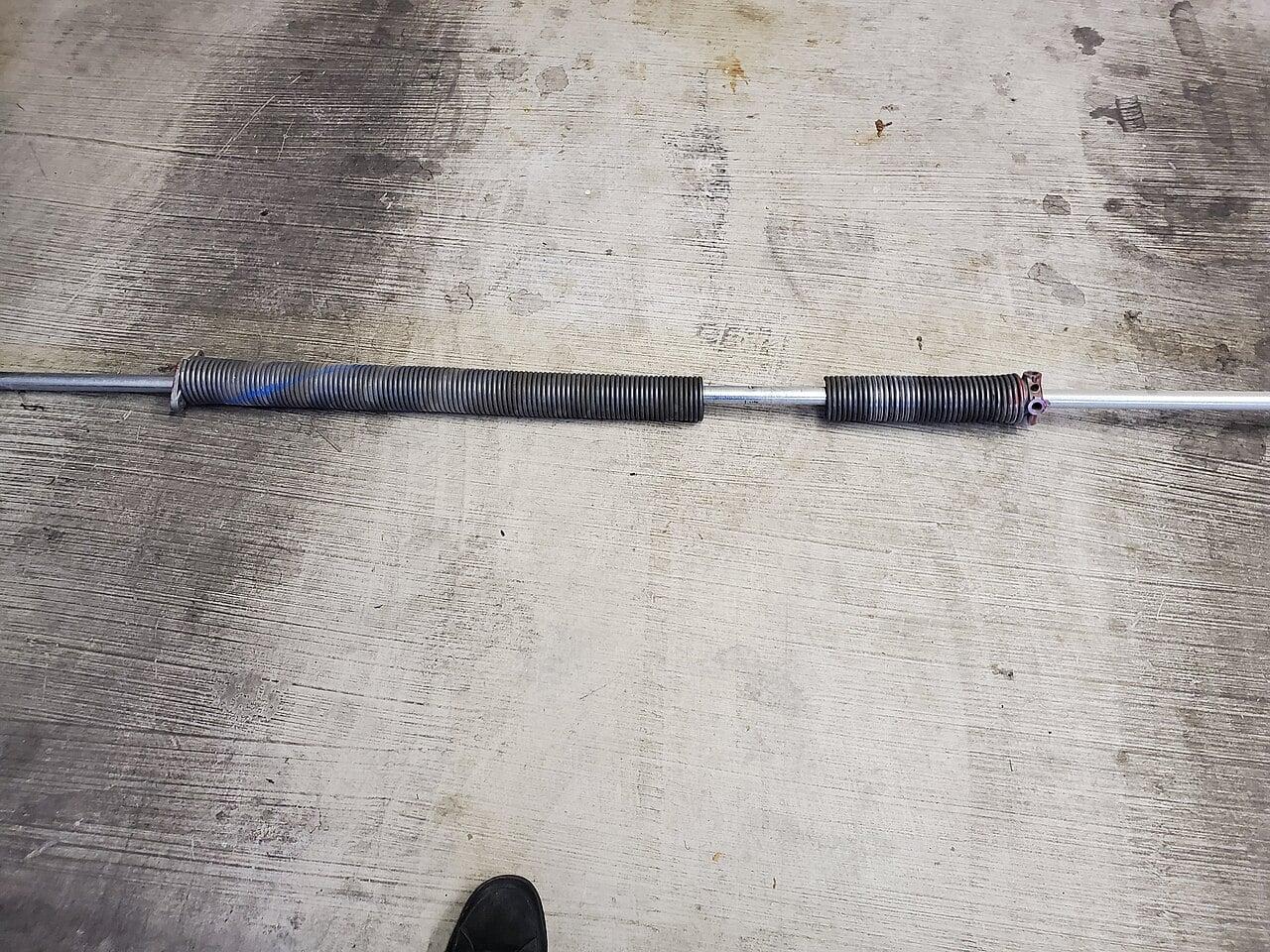
- Gap between coils — a properly wound torsion spring has no daylight between active coils when the door is closed. Visible gaps mean the spring has taken a permanent set. It has lost its torque reserve.
- Rust streaks running down the spring — surface rust is cosmetic. Rust that follows the coil spacing into the wire indicates moisture has penetrated the oil film. That spring is living on borrowed time.
Extension springs show stretch marks: the coils near the hook ends elongate first. When the hooks themselves start to open, the spring is one hard cycle from letting go.
What the operator tells you
A commercial jackshaft operator (LiftMaster Maxum, Manaras, Hörmann) logs cycle counts and force profiles. Pull the data. A 15 percent increase in average run current over thirty days, with no change in door weight or weather, almost always means the spring is losing torque.
Photo-eyes and edge sensors do not cause this pattern. If the door reverses at the same spot every cycle, that is a sensor or track issue. If the door slows at the same spot — especially the first twelve inches off the floor — the spring is not delivering rated lift.
The cold-weather multiplier
Below 5 °C, oil viscosity inside the spring wire rises. A spring that was marginal in October becomes critical in January. The first hard freeze of the year is when we get the most “door won’t open” calls on springs that showed every sign since November.
If you operate unheated warehouses in Richmond, Delta, or the North Shore industrial corridors, treat the first frost as your inspection deadline. Cycle the doors manually. Feel for binding. Listen for the pitch change.
What to do when you spot the signs
Do not add turns to a tired spring. Extra tension masks the symptom for a few dozen cycles, then the spring fails at a higher stored energy — more violent, more dangerous.
Do not replace one spring of a pair. The mate has the same cycle count. Replace both. Match the wire size, inside diameter, and length to the door weight and track radius. A mismatched spring over-stresses the shaft, the drums, and the operator.
If the door has taken a vehicle impact, assume the spring is compromised even if it looks intact. The shock load travels through the shaft into the coils. Micro-fractures do not show until the next cold snap.
When to call
You have the signals. You have the cycle count. You have a door that feeds a loading dock, a parkade, or a fire lane. The cost of a planned spring change during daylight hours is a fraction of an emergency call at 2 a.m. with a truck backed up to the dock.
We carry standard commercial spring sizes on the truck. 30–45 minutes to most Richmond industrial areas during business hours; 30–60 minutes at 2 a.m. The voice AI answers every call, captures the door specs, and dispatches the nearest tech with the right springs before you hang up.
Call (604) 206-5727 — Metro Vancouver.