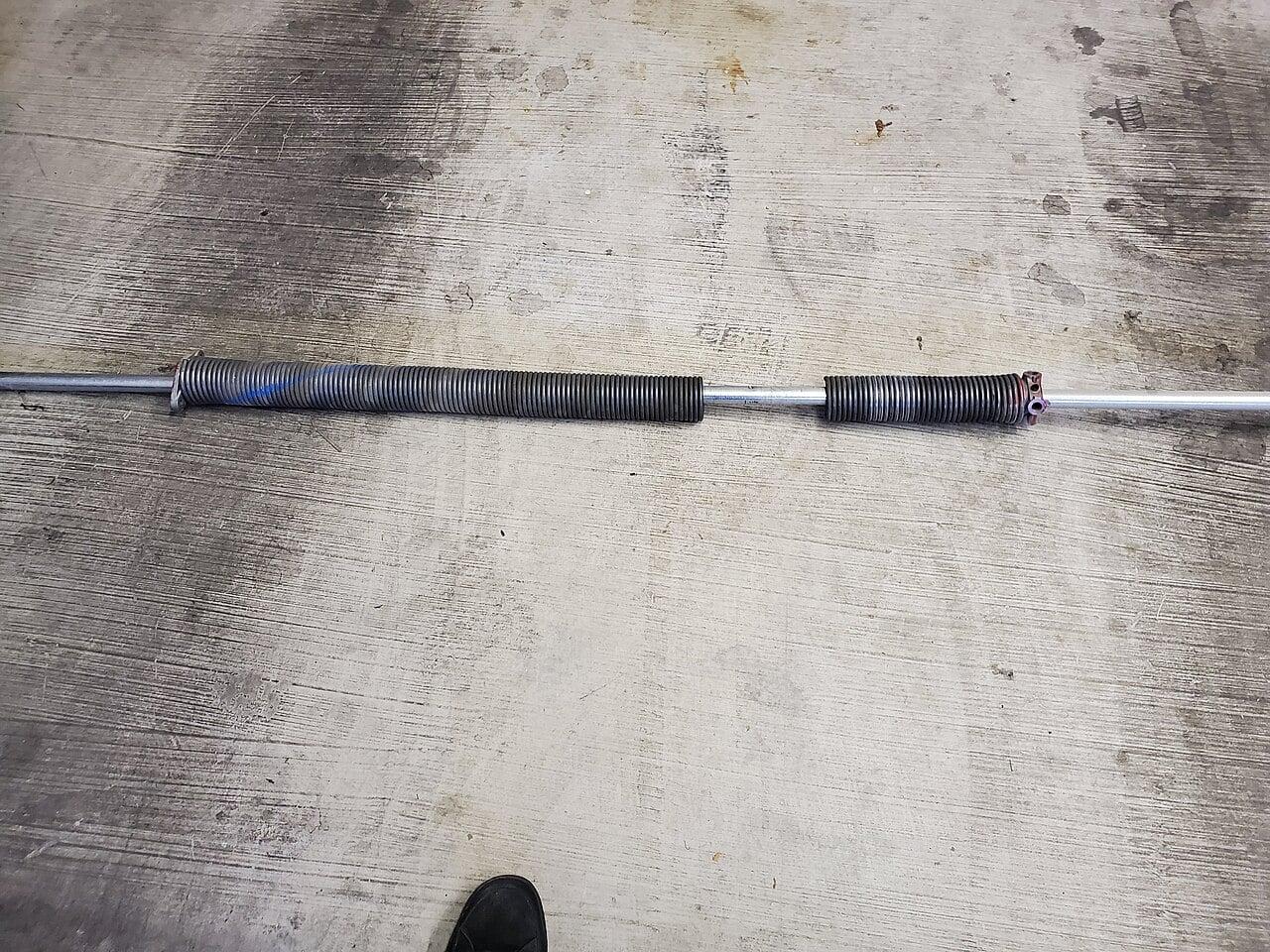
Short answer. Spring anchor brackets hold the stationary end of every torsion spring to the wall, and the end bearing plates carry the shaft at each side. Clopay's commercial manual requires red coloured fasteners on the anchor brackets, a warning label in plain view, and a solid anchor pad behind them. On doors 20 feet or wider, and on doors of 730 lb and up, it adds an extra anchor bracket with a bearing near each drum. If the pad behind a loaded bracket splits, that's an emergency.
Spring anchor brackets don't get much attention until one pulls off a wall. On a commercial sectional they take every inch pound the springs make and pass it into the building. The end bearing plates do the other half of the job and keep the shaft level at each side of the door. Together they decide whether the counterbalance stays where it was installed.
Safety, in plain words. Clopay's commercial manual says never remove a spring anchor bracket when springs are wound. Red fasteners mean spring tension. If you see red bolts or lags on your door, leave them alone. Call a trained tech.
What spring anchor brackets do
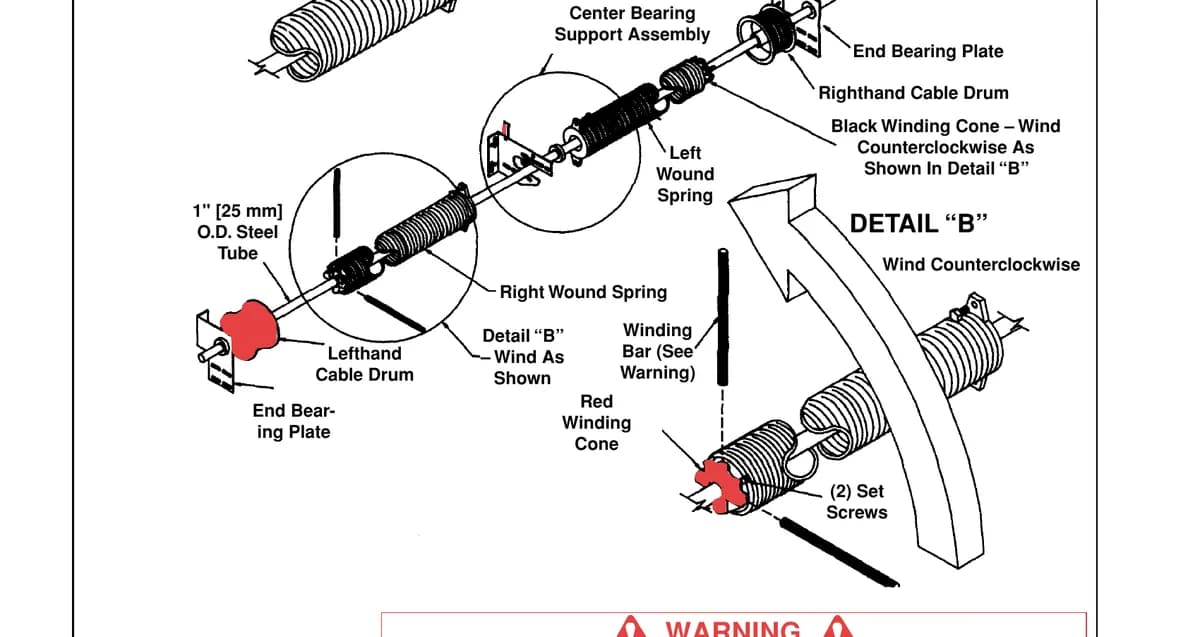
Each stationary spring cone bolts to a spring anchor bracket. The bracket is fastened to the header or jamb. When the spring is wound, the cone tries to rotate and the bracket stops it. All the lifting torque the door needs is reacted through that bracket and its fasteners.
Clopay's manual says spring anchor brackets anchor the springs to the wall and must be fastened securely with red coloured fasteners. It lists 5/16 by 1 5/8 inch red lag screws for wood and 5/16 by 1 inch red self tapping screws for steel jambs. All torsion spring doors ship with a red warning label, and those labels must be on all spring anchor brackets in plain view. A missing label is the installer's problem to fix.
The anchor pad behind the bracket
A bracket is only as good as what it's screwed into. Clopay's commercial manual is specific about the pad. A wood anchor pad must be Grade 2 or better Southern Yellow Pine, at least 2 by 6 by 12 inches, and sound. It says not to use wood labelled spruce pine fir. A steel pad must be at least 1/4 by 10 by 12 inches and securely fastened to the structure.
The wood pad goes on with at least four 3/8 by 3 inch lags, one near each corner, kept at least 1 1/2 inches from the edges and ends. They must bite the structural frame, not drywall. Under no circumstances should the pad go up with nails. On concrete or block walls the manual allows four 3/8 inch masonry anchors. And if the wood splits once the spring is in place, a professional replaces it.
Two shortcuts show up on older buildings. A new door hung on an old pad nobody checked, and a pad shimmed off a stud with no frame behind it. Our view is simple. If we can't see what the bracket is fastened into, we don't wind springs against it until we know.
End bearing plates and the shaft
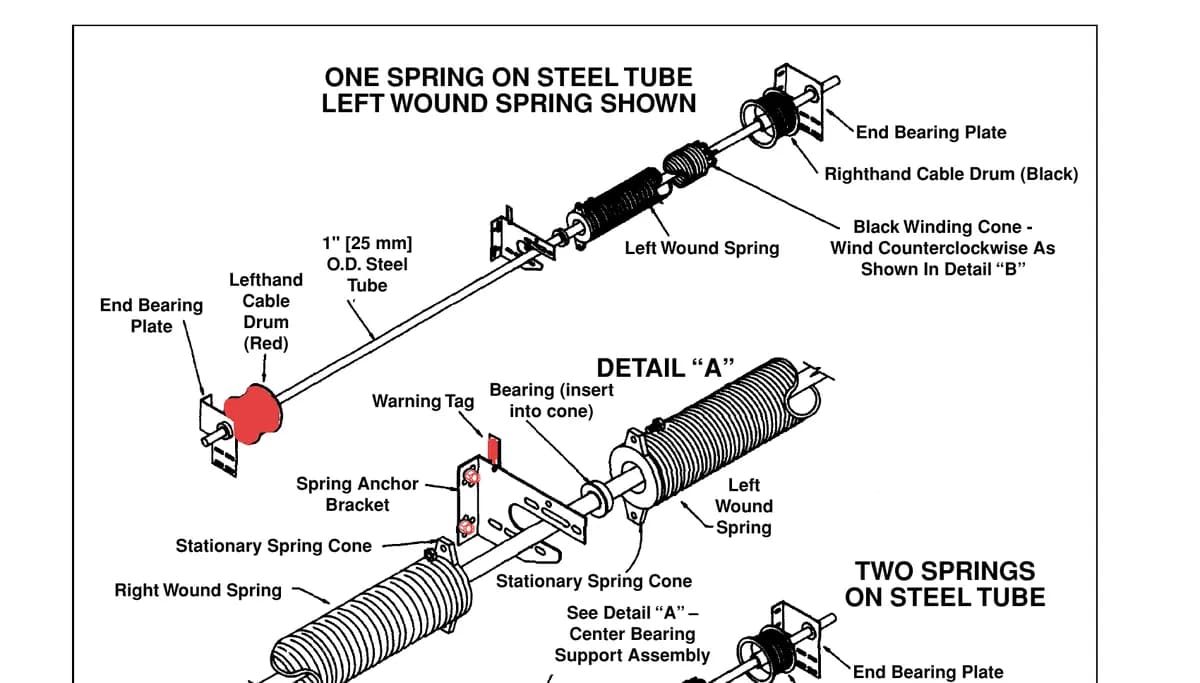
At each end of the shaft, an end bearing plate holds a bearing that the shaft turns in. The drums sit tight against those plates. Clopay's procedure starts with the left drum slid against its end bearing plate. A bearing that's dry or collapsed lets the shaft wander side to side, and DASMA Technical Data Sheet 190 notes that side to side shaft movement can upset spring stretch and cause coils to rub.
Auxiliary supports on wide and heavy doors
Wide doors bend the shaft. Clopay handles that with auxiliary supports, and it gives the rule in a footnote.
| Condition | Clopay requirement |
|---|---|
| Doors 20 ft or wider, or 730 lb and heavier | Extra spring anchor bracket with bearing and retainer, about 3 inches in from each drum |
| Doors over 20 ft wide with only two springs | Auxiliary support bearing halfway between spring and drum |
| All auxiliary bearings | Assembled on the shaft before the drums go on |
That last line matters on a repair. You can't add an auxiliary bearing to a loaded shaft without taking the counterbalance apart. When we quote a spring change on a wide door with no auxiliary support, we say so up front.
What to report
From the floor, with power locked out, look for a bracket that has moved, cracked paint around its lags, a split in the wood pad or a shaft that isn't level. Call (604) 206-5727 and describe it. The winding cones page covers the other half of this hardware. For whole door problems see commercial spring repair. Why springs break and operators fail is worth a read, as is the bay door spring repair page. Wide doors with several springs are on multi spring and duplex setups.