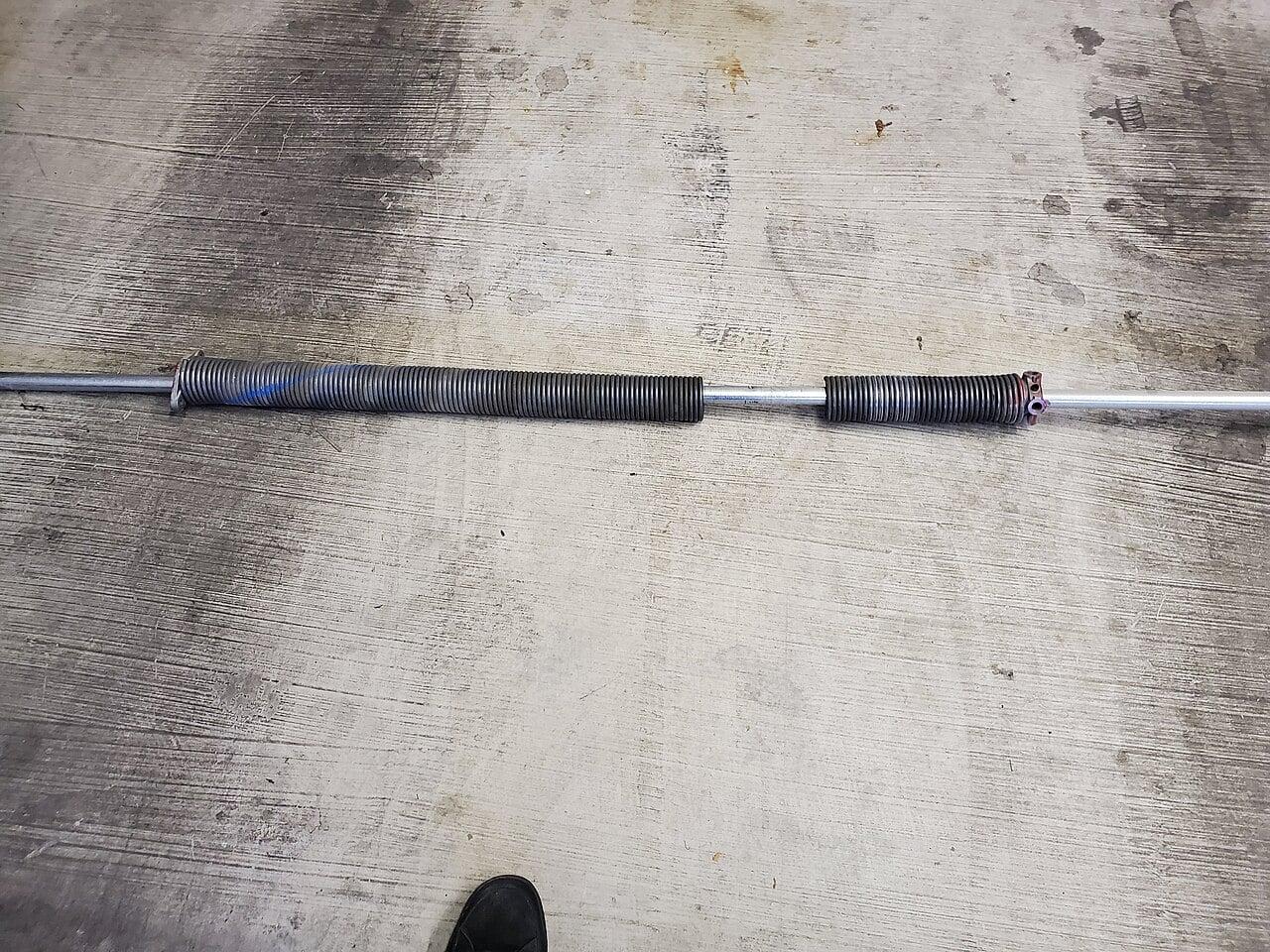
Short answer. Torsion spring winding cones are the cast ends of a spring. The stationary cone bolts to the spring anchor bracket and never turns. The winding cone sits on the shaft, takes the winding bars, and is locked with two set screws. Clopay's commercial manual says those set screws go about 1 1/4 turns past first contact on a solid shaft, and no more than 1/2 turn on a torque tube. A cracked or slipping cone is a spring replacement, not a tightening job.
Every torsion spring on a commercial sectional has two torsion spring winding cones, one at each end, though only one of them actually winds. They're the most abused part of the counterbalance and the least understood. Building staff see a spring and a shaft. We see the two castings holding all that torque, and the two small set screws keeping it on the shaft.
Plain warning first. Cones are under full spring tension whenever the door is closed. Clopay's manual tells installers never to remove a spring anchor bracket when springs are wound and to wind only with solid steel bars of the right size. Nobody else should put a tool on a cone. Ever.
Torsion spring winding cones and stationary cones
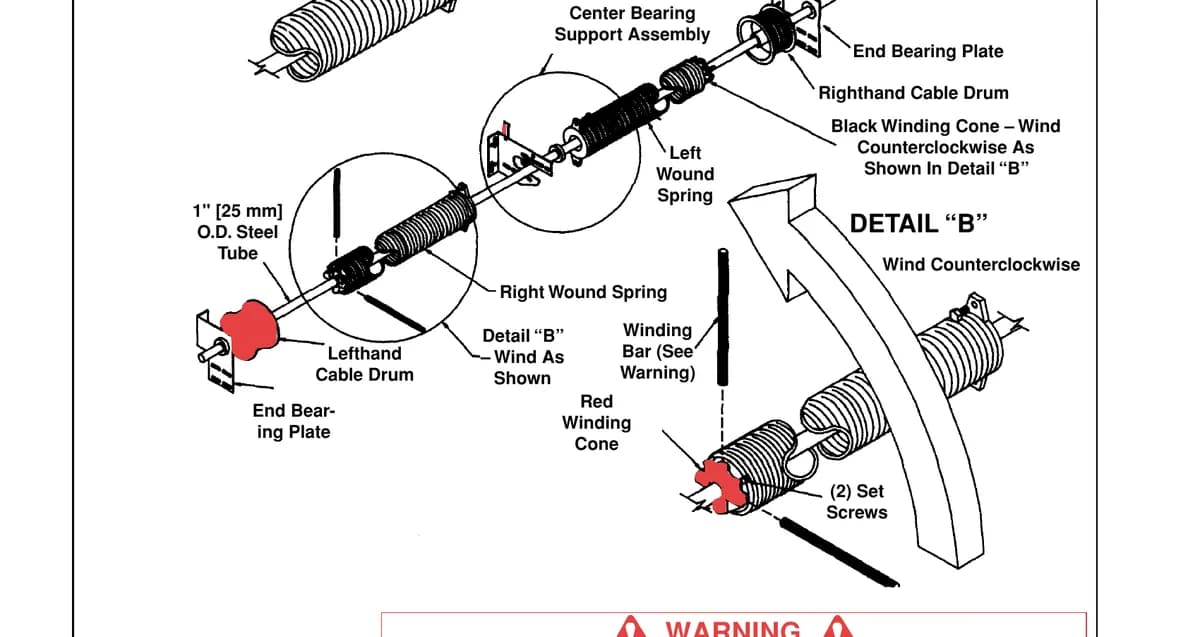
Clopay names the parts on its commercial drawings. One end is the stationary spring cone, also called the spring anchor cone. It is bolted to the spring anchor bracket, and the bracket is fastened to the wall with red coloured fasteners. The other end is the spring winding cone. It slides on the shaft and carries the holes for the winding bars.
When a tech winds the spring, the winding cone turns and the stationary cone holds. Once the turns are on, the winding cone is locked to the shaft with set screws. From then on the shaft, drums and winding cone all move together as the door runs.
Set screw rules from the manual
Set screws are where cones fail. The Clopay commercial manual gives two different rules depending on the shaft.
| Shaft type | Clopay set screw rule |
|---|---|
| Solid shaft | Tighten enough to dimple the shaft, about 1 1/4 turns after the screws first hit the shaft |
| Torque tube | Do not exceed 1/2 turn after the screws contact the shaft |
| Both | Place the two set screws 90 degrees apart |
Too loose and the cone slips under load. The door drops faster than it should and the cable can come off the drum. Too tight on a hollow tube and the screw crushes the tube wall. That's the reason the two rules differ.
Colour codes on cones
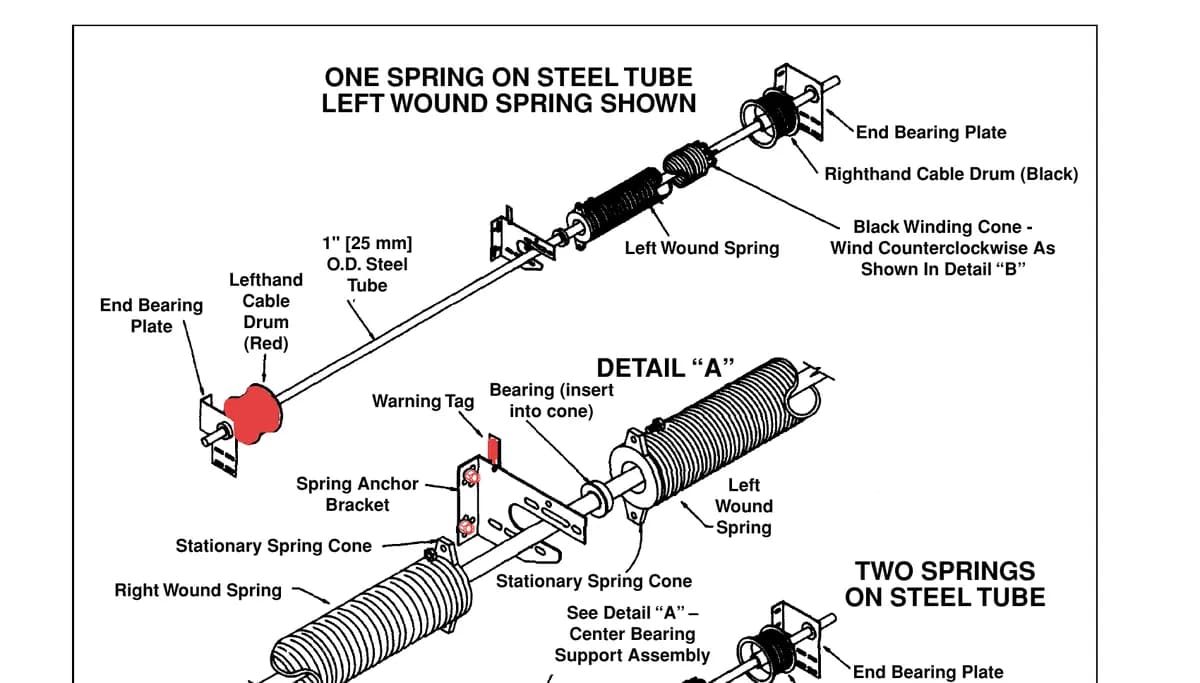
Clopay's drawings show a black winding cone on the left wound spring and call for red drum set screws on the left hand drum. Their residential supplement uses red and black cones to show which side of the door a spring belongs on. Other makers use their own paint. The point is the same. Cone colour tells you wind direction and side, and a left wound spring on the wrong side unwinds instead of lifting.
Cracked and worn castings
DASMA Technical Data Sheet 190 warns that dropping or throwing a torsion spring on a hard surface can crack the cast spring fittings, and that a cracked fitting can fail during installation and injure the installer. The same sheet says to avoid letting the active coils turn while a spring is threaded onto a cone.
So when we find a cone with a crack, a chewed bar hole or a wallowed out set screw thread, we replace the spring. Our call here is firm. We don't reuse cones off a broken commercial spring, and we don't move a cone from one spring to another. A new spring comes with new cones made for that wire. Saving an old casting is a bad trade on a door this heavy.
What a facility can check
From the floor, with the door closed and the operator locked out, you can look for a few things. A gap opening between the last coil and the winding cone. Shiny marks on the shaft beside a cone, which mean it has walked. Rust streaks running off the set screws. Any of those is a call to us at (604) 206-5727, not a reason to grab a wrench.
Look and listen guidance is on commercial door spring failure signs and what a failing torsion spring sounds like. The cones bolt to brackets and plates, explained on spring anchor brackets and bearing plates. For sizing, the torsion spring wire size chart and the torsion spring size page go together. Repairs are on our commercial spring repair page.