A rolling fire door sits open every day. In a fire, it has one job: close completely, latch, and stay closed long enough to contain flame and smoke. The mechanism that makes that happen is simple, but it has no redundancy. If any part fails — fusible link, governor, guide, or latch — the door does not work. There is no second chance.
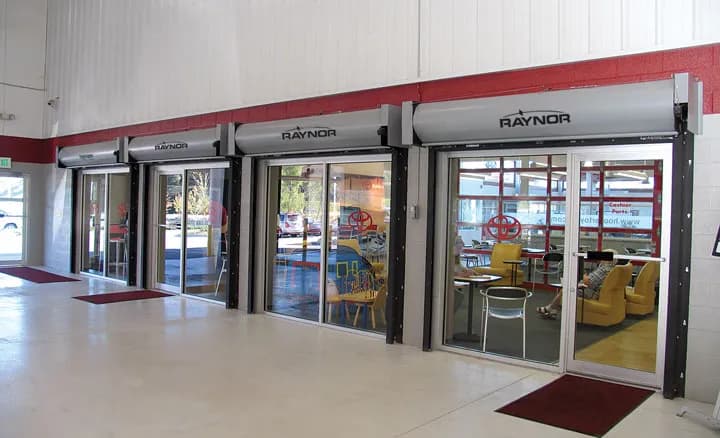
Fire shutters operate on the same principle. The difference is mostly in the curtain material and the rating. A fire-rated rolling door uses interlocking steel slats. A fire shutter typically uses a lighter curtain, often a composite or steel fabric, rated for the same fire endurance but not for impact or security. Both rely on a governed drop. Both need annual drop testing. Both become liabilities the moment they are skipped.
What actually happens when the fusible link melts
The fusible link is a calibrated metal alloy rated to release at a specific temperature — usually 165 °F (74 °C) for standard applications, higher for special hazards. It holds the door open by keeping tension on a release lever or cable. When the ambient temperature at the link hits its rating, the alloy yields. The lever rotates or the cable slackens. The door is free to fall.
Gravity does the rest, but not on its own. A governor — either a centrifugal brake inside the barrel or a viscous dashpot on the side — controls the descent speed. The target is 6 to 24 inches per second. Too fast and the bottom bar slams the floor, damaging the latch and possibly bouncing. Too slow and the door may not fully close before the fire reaches the opening. The governor is the only thing between a controlled close and an uncontrolled crash.
Once the bottom bar contacts the sill, the latching mechanism engages. On a rolling door, this is usually a self-locking bottom bar or a separate latch bolt that drops into a strike in the floor or threshold. On a fire shutter, it may be a hook latch or a magnetic catch. The latch must hold against the positive pressure of a fire on the other side. If the door rattles or the latch does not catch, the assembly fails its rating.
Why a fire door that has never been drop-tested is a liability
A door that has never been drop-tested is not a fire door. It is a steel curtain hanging on a hope. The fusible link may have been painted over. The governor may be seized from years of dust and humidity. The guides may be bent from a forklift hit three winters ago. The latch may be missing its strike plate. None of these faults show up in daily operation because the door never moves. The first time it moves is the fire — and then it is too late.
The BC Fire Code adopts NFPA 80. Annual drop testing is mandatory. The test verifies three things: the door releases at the fusible link temperature (or a simulated release), the governor controls the drop speed within the 6–24 in/s range, and the door fully closes and latches without binding, bouncing, or stopping short. A written record must be kept on site. If you cannot produce it, the door is non-compliant.
Common failure modes we see on test day:
- Fusible links painted, corroded, or replaced with the wrong temperature rating
- Governors seized or missing entirely — door free-falls
- Guide wear or damage causing the curtain to bind halfway down
- Bottom bar bent so the latch cannot engage
- Obstructions stored under the door (pallets, bins, equipment) preventing full closure
- Missing or illegible fire labels on the curtain or frame
Any one of these fails the test. The door must be repaired and re-tested before the building is compliant.
Fire-rated rolling door vs. fire shutter — what changes
The governing standard is the same. The installation requirements are the same. The testing schedule is the same. The differences are practical:
| Factor | Rolling fire door | Fire shutter |
|---|---|---|
| Curtain | Interlocking steel slats (typically 22–18 ga) | Steel fabric, composite, or lighter gauge slats |
| Typical rating | 1.5 hr, 3 hr, 4 hr (labelled) | 1.5 hr, 3 hr (labelled) |
| Impact resistance | High — rated for forklift/vehicle contact | Low — not rated for impact |
| Security | Can be used as a security grille when closed | Not a security barrier |
| Common locations | Loading docks, fire separations in warehouses, parkades | Corridor openings, service counters, atrium closures |
| Operator options | Chain hoist, motor operator with fire release | Motor operator with fire release, rarely manual |
If the opening needs to resist a forklift hit or serve as a secure closure after hours, a rolling fire door is the correct choice. If the opening is a corridor penetration or a service window where impact is not a concern, a fire shutter costs less and weighs less. Both must be drop-tested annually. Neither is optional.
Installation details that affect compliance
The door assembly includes the curtain, barrel, guides, bottom bar, hood, fusible link, governor, and latch. All components must be listed and labelled as a system. You cannot mix a listed curtain with an unlisted governor or a field-fabricated guide and expect the label to hold.
Clearances matter. NFPA 80 allows a maximum 3/8-inch clearance between the curtain edge and the guide. Excessive clearance lets flame and smoke bypass the curtain. Guide mounting must be solid — lag bolts into wood blocking or through-bolts into steel. Powder-actuated fasteners into concrete are acceptable only if the manufacturer’s instructions permit them. We have seen guides held by drywall screws. They pull out under fire pressure.
The hood protects the barrel and the fusible link from debris and overspray. A missing hood is a common deficiency. So is a hood that has been cut open for a motor operator and never resealed. The fusible link must be located per the listing — usually at the lintel, centered over the opening. Relocating it to “a more convenient spot” voids the rating.
What to do before the inspector arrives
Walk every fire-rated rolling door and fire shutter in the building. Look for:
- Current fire label on the curtain and frame (legible, not painted over)
- Hood in place, undamaged, sealed at penetrations
- Fusible link visible, correct temperature rating, not painted or corroded
- Governor present and appears intact
- Guides straight, securely fastened, no excessive gap to curtain
- Bottom bar straight, latch present, strike plate in place and aligned
- Area under the door clear — no storage, no parked equipment
- Previous drop test report on site, dated within 12 months
If you find a deficiency, fix it before the test. A failed test means a repair visit, a re-test, and a gap in your fire protection record. The cost of the repair is almost always less than the cost of the delay.
Next step
If your rolling fire doors or fire shutters are due for annual drop testing, or if you have doors that have never been tested, schedule the inspection. We perform drop tests to NFPA 80 across Metro Vancouver and provide the written records the fire inspector expects. Call (604) 206-5727 — 24-hour emergency service across Metro Vancouver.