Bottom-rolling multi-leaf doors: the fleet workhorse
Bottom-rolling hangar doors carry the weight on floor-mounted trucks that run in a steel track embedded in the apron. The top guide rollers only keep the leaves plumb — they do not carry load. That distinction matters when the floor settles.
On the South Coast, the apron slab is rarely a monolithic pour. It was placed in sections, often over different subgrade prep, and the water table sits high through winter. Differential settlement of 10 to 15 mm across a 30-metre opening is common. The track twists. Truck wheels bind. The drive motor — usually a single operator on the lead leaf — starts tripping its thermal overload because it is pushing a bent track, not a door.
What fails first:
- Truck wheel bearings seize from grit and standing water in the track
- Guide rollers at the header wear oval, letting leaves sway in a crosswind
- Drive chains stretch and jump sprockets when the lead leaf racks
- Bottom weather seal tears off on the low spot of a settled slab
If you are at YVR’s south-side hangars or the GA rows at Boundary Bay, you have seen this. The fix is not “adjust the track.” The track is bolted to a slab that moved. You either shim the track back to straight — a temporary measure — or you cut the slab, repack, and re-pour the track section. Anything else is a callback waiting for the next king tide.
Bifold doors: straps, cables, and the cycle counter
A bifold hangar door lifts as a single panel hinged at the header, pulled up by straps or cables running to a winch at the sidewall. The panel becomes its own lintel when open. That means the header sees the full dead load of the door plus wind load — no track to share it.
On the coast, two things accelerate wear: 1. Corrosion on the lift cables. Marine air carries salt. Galvanized aircraft cable lasts 3,000 to 5,000 cycles in this environment before you see broken wires at the thimble. Stainless cable doubles that, but the winch drum and sheaves still rust unless they are stainless too. 2. Strap elongation. Synthetic lift straps stretch under load. A 12-metre door panel weighing 1,800 kg stretches a 25 mm polyester strap measurably over a season. The limit switches drift. The door stops short of full open, or over-travels and slams the header.
The winch brake is the single point of failure. If it slips, the panel free-falls. There is no torsion spring to catch it. Every bifold inspection must include a brake torque test with a calibrated wrench — not a “feels tight” check.
Hydraulic one-piece doors: the hidden system
Hydraulic swing-up doors look simple. A single panel, hinged at the sill, pushed up by two or four cylinders fed from a power unit in a heated cabinet. The panel locks over-center at full open. No cables, no winch, no track.
What goes wrong:
- Seal failure on the rod side. The cylinder extends 3 to 4 metres. The rod spends half its life exposed to driven rain and UV. Chrome pitting starts at the wiper. Within two years you have weeping seals and oil on the apron.
- Counterbalance valve drift. The valve holds the panel at any position. When it wears, the door creeps down under its own weight. You find it half-open at 6 a.m. with no one on site.
- Power unit overheating. The reservoir is sized for a 50% duty cycle. In a busy flight school, the door cycles 40 times an hour on a summer Saturday. The oil hits 90°C. Viscosity drops. The pump cavitates. The relief valve chatters.
The fix is usually a larger reservoir with a fan cooler and a rod boot on every cylinder. It is not glamorous. It works.
Wind load on the coast is not a design wind speed — it is a daily event
The westerlies off the Strait of Georgia run hard across the airfield through fall and winter, and 80 km/h gusts show up every November. A 14-metre wide by 6-metre tall hangar door sees 1,800 kg of wind force at 80 km/h. That load goes into the building structure through the door’s mounting points.
On a bottom-rolling door, the wind pushes the leaves against the guide rollers at the header. The rollers are typically 50 mm nylon on a 12 mm shaft. The shaft bends. The roller cracks. The leaf twists in its frame. You end up with a door that binds at the top but rolls free at the bottom — or vice versa.
On a bifold, the wind load tries to peel the panel off the hinge line. The header connection sees tension, not compression. If the original installer used 12 mm anchor bolts into 200 mm concrete with no epoxy, the anchors pull out. The lasting repair is through-bolted steel plates backed by welded stiffeners — not another set of expansion anchors in the same cracked concrete.
On a hydraulic door, the wind load feeds back into the cylinders. The counterbalance valve sees pressure spikes it was not sized for. The relief valve opens. Oil dumps to tank. The door drifts down — sometimes while an aircraft is taxiing under it.
What a proper inspection covers
You do not need a 50-point checklist. You need these five measurements, recorded every visit:
1. Track straightness — string line or laser across the full run, recorded in mm deviation per 3 m 2. Cable/strap tension — tension meter reading at mid-span, compared to install spec 3. Cylinder rod condition — visual for pitting, micrometer at the wiper if weeping 4. Header anchor torque — spot-check 10% of anchors to 80% of rated torque 5. Cycle counter — every operator and winch should have one. If it does not, install one.
The cycle count tells you when to replace cables, straps, and seals before they fail. A bottom-rolling door at a busy FBO hits 10,000 cycles a year. A private hangar at Langley might hit 400. The maintenance interval is cycles, not months.
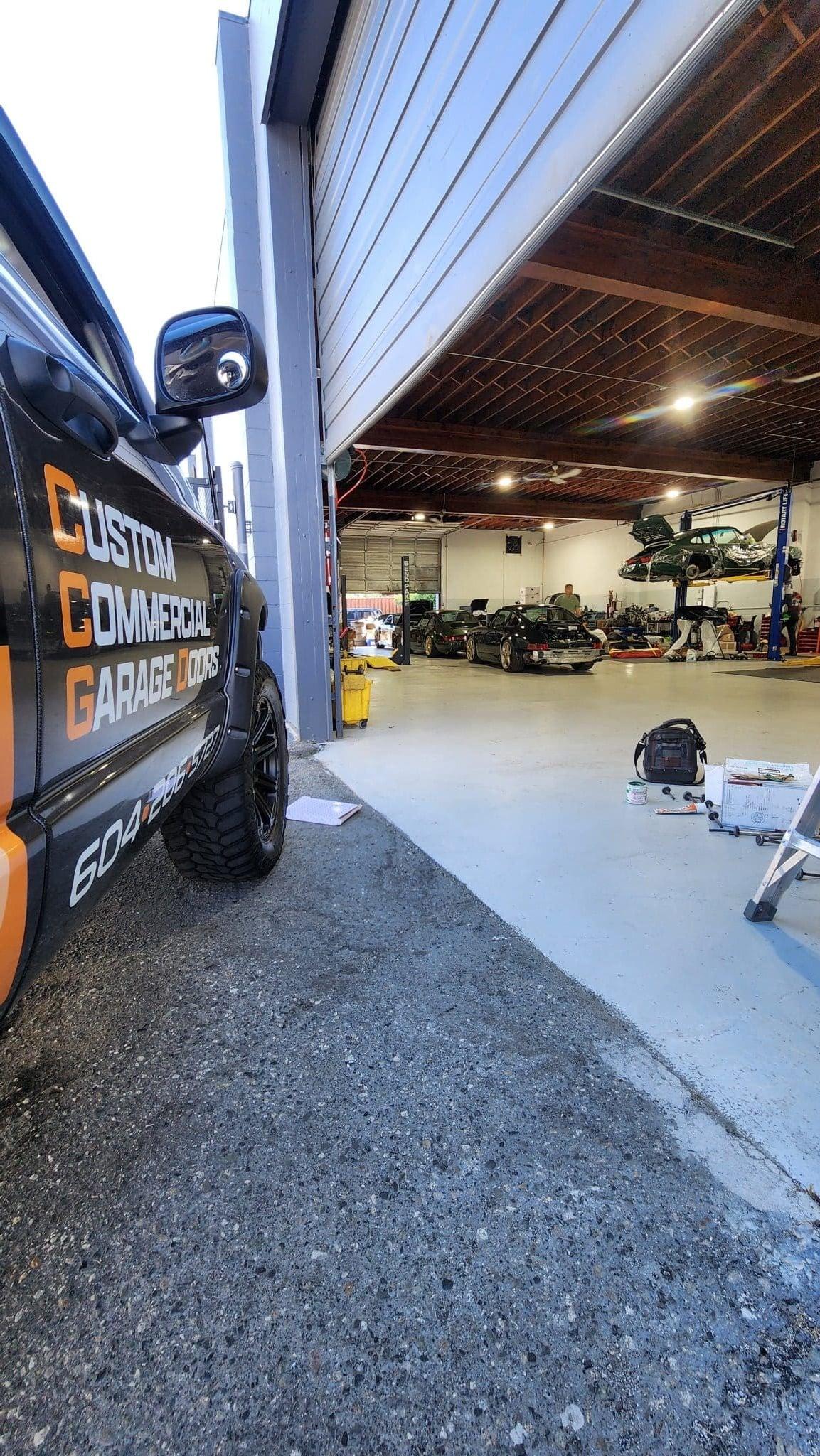
CCGDS on River Road — minutes from the south side
Our shop sits at 7080 River Rd in Richmond. From the yard gate to the YVR south-side hangar row is six minutes in light traffic. To Boundary Bay, twelve. That proximity matters when a door is stuck half-open with an aircraft behind it and weather moving in.
We work on all three door types. We do not sell one system and call the others obsolete. The right door is the one that matches your operation, your budget, and the wind exposure on your specific leasehold.
Next step
Call (604) 206-5727 or email info@ccgds.ca. Describe the door type, the symptom, and the leasehold address. We will tell you what the first site visit needs to include and what parts to bring.