Insulated Commercial Garage Doors Vancouver — R-Value, Polyurethane, and What Actually Matters
June 13, 2026
Insulated commercial garage doors — R-value guide, Metro Vancouver
R-value is the number the door industry uses to sell insulated commercial doors and it is frequently misunderstood. A door rated R-16 does not perform like a wall rated R-16. The door is a smaller portion of the opening than the wall area, it has frames and tracks that conduct heat differently than the panel, and the seal perimeter matters as much as the panel insulation.
Understanding this gap — between what the spec sheet says and how the door actually performs — is the difference between a good investment and an expensive disappointment.
Polyurethane vs Polystyrene
Commercial insulated doors use one of two foam insulation types. Polystyrene is cut-to-fit rigid foam inserted into a pre-formed panel cavity and sandwiched between the inner and outer steel faces. Polyurethane is foamed-in-place — liquid chemicals are injected into the panel cavity and expand and cure to fill the cavity completely, bonding to both steel faces.
Polyurethane is superior for commercial applications for three reasons. First, higher R-value per inch — polyurethane runs R-6 to R-7 per inch, polystyrene runs R-4 to R-5. Second, structural — the foamed-in-place polyurethane bonds to both steel skins and creates a structural composite panel that resists denting better than a polystyrene insert. Third, no air gaps — polystyrene panels can develop gaps at the edges as the foam shrinks slightly over time. Foamed-in-place polyurethane fills completely and maintains that fill.
In practice, a 2-inch polyurethane panel achieves roughly R-12 to R-14 effective, while a 2-inch polystyrene panel achieves roughly R-8 to R-10. The difference accumulates meaningfully in a facility that runs climate control year-round.
Thermal Break Construction
A commercial steel door panel has an outer steel face, insulation, and an inner steel face. If the outer and inner faces are in direct contact at the panel edges the steel edge acts as a thermal bridge bypassing the insulation entirely. Thermal break construction interrupts this path. A non-conducting material separates the inner and outer steel faces at the panel edges. On Amarr commercial thermal break panels the effective R-value is meaningfully higher than on non-thermal-break panels of the same nominal thickness.
Thermal break matters most in cold storage, refrigerated loading docks, and food processing facilities where both sides of the door see large temperature differentials. In a facility at 2°C with a Vancouver winter exterior at -5°C, the steel edges on a non-thermal-break door will condense moisture, accelerating corrosion and reducing effective insulation over time.
Door Thickness and R-Value Reference
Panel thickness is the primary determinant of R-value for a given foam type. These are approximate ranges for commercial polyurethane sectional doors:
1-3/8 inch panel — R-6 to R-8
1-3/4 inch panel — R-9 to R-12
2 inch panel — R-12 to R-16
3 inch panel — R-16 to R-21
The jump from a 1-3/4 inch to a 2 inch panel is often the most cost-effective upgrade. Above R-16, diminishing returns set in for most commercial applications unless the space is refrigerated or controlled to tight tolerances.
Installation Quality and Seal Perimeter
The best-specified door in the world performs poorly if it has a failed seal perimeter. We have inspected commercial doors with excellent panel R-values that had visible daylight at the side seals and a bottom seal that was completely flat. The thermal performance of that door was poor regardless of what the spec sheet said.
A properly installed insulated sectional door requires:
Compression side seals that maintain contact across the full height of the door without binding
A bottom seal in good condition — typically a P-type bulb or T-bottom seal, replaced when it loses its profile
A header seal that closes the gap between the top panel and the header framing when the door is closed
Panels that sit flush in the tracks without twisting or racking
These are maintenance items, not installation-and-forget. A bottom seal on a busy loading dock typically needs replacement every two to three years. Ignoring it negates a significant portion of the panel’s thermal value.
Which Applications Actually Benefit from High R-Value
Not every building needs R-16 panels. The right specification depends on what the space is used for and how the building is conditioned.
Cold storage and refrigerated facilities benefit most from the highest achievable R-value, thermal break panels, and high-quality seals. These doors also require attention to condensation — a vapor barrier on the warm side prevents moisture from migrating into the panel cavity.
Heated warehouses and manufacturing facilities benefit from R-12 to R-16 panels when the door faces a heated area. Uninsulated doors on a heated warehouse represent a direct energy loss proportional to the door area and the temperature differential.
Auto shops and commercial garages that heat the space are good candidates for insulated doors, particularly on the main service bays. Mechanics working in an uninsulated space with a large door opening lose heat rapidly during Vancouver winters — doors open and close dozens of times per day.
Strata parkades and residential parking structures typically do not need high insulation. The spaces are not climate-controlled and the door is mainly a security barrier. A basic uninsulated or minimally insulated door is the standard specification here.
Loading docks with dock levellers present a more complex case. When the dock door is open and a truck is docked, the insulation value of the door is irrelevant. The thermal performance question shifts to dock shelter and dock seal quality — the gap between the truck body and the dock opening. Here, a high-performance dock shelter contributes more to thermal control than a thicker door panel.
Vancouver Climate and the BC Energy Step Code
Metro Vancouver sits in a mild marine climate. Heating degree days for Richmond are roughly 2,800 to 3,000 annually — considerably lower than Interior BC cities. This means the ROI on ultra-high insulation is lower in Vancouver than in Kelowna or Prince George. However, Vancouver’s overnight lows in January regularly reach -5°C to -8°C, and a large uninsulated door on a conditioned space will cycle substantial heat loss during a typical winter week.
The BC Energy Step Code applies to new commercial construction and sets minimum thermal envelope requirements. Existing commercial buildings undergoing significant renovation may also be subject to current standards. When we specify a replacement door on a permitted project we ensure the panel R-value meets or exceeds current code minimums for the climate zone.
The Upgrade Path: What Changes When You Upgrade
Replacing an existing non-insulated or low-insulation commercial door with an insulated sectional door is a full replacement job, not a panel-by-panel swap. The sections, springs, hardware, and often the tracks and cable drums are all sized to the panel weight. Adding insulated sections to a spring system sized for uninsulated panels changes the load balance and can cause the springs to fail prematurely or the opener to overload.
What the upgrade typically involves:
Removal of the existing door, spring assembly, and hardware
New insulated sectional panels sized to the opening
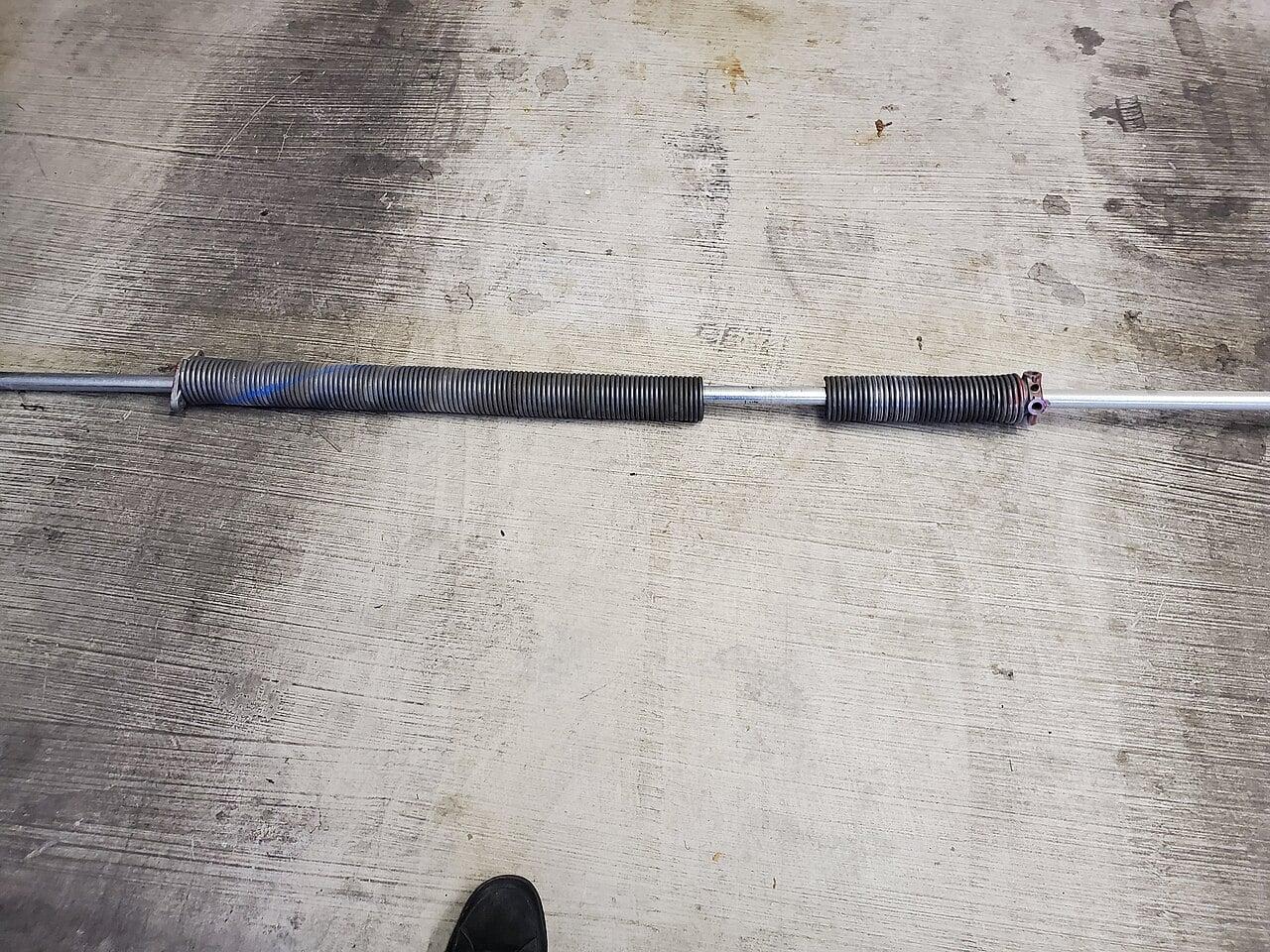
New torsion springs sized to the new panel weight
New lifting cables, drums, and brackets if the existing hardware is worn
Track and header assessment — insulated panels are heavier and the tracks must handle the load
Seal perimeter installation — side seals, header seal, bottom seal
If the existing opener is marginal, we assess it at the same time. A 1/2 HP residential opener on a commercial door is a common situation in older warehouse spaces — it may have handled an uninsulated door but will struggle with the added weight and should be replaced.
Sectional Doors vs High-Speed Doors for Thermal Applications
High-speed roll-up doors are sometimes specified as an alternative to insulated sectional doors in high-traffic applications. The argument is that a fast-cycling door reduces the total time the opening is exposed, which can offset the lower insulation value of the door itself.
This is valid in specific situations — a very high-cycle entrance where the door sees 50 or more cycles per hour, for example. For most commercial spaces, a well-insulated sectional door on an appropriate opener is the better thermal and cost choice. High-speed doors require more maintenance and have higher failure costs than conventional sectional hardware.
The best outcome in some facilities is both: a fast-cycling high-speed door on the exterior face, with an insulated sectional door behind it as a backup and the primary thermal barrier.
Condensation and Vapor Barrier in Cold Applications
In refrigerated spaces, condensation on the interior face of a door panel signals that warm humid air is reaching a cold surface. This happens when the effective R-value of the panel is insufficient for the temperature differential, or when air is bypassing the panel through a failed seal.
Persistent condensation accelerates corrosion of the inner steel face, degrades the foam insulation over time, and can create ice buildup at the bottom seal in below-freezing applications. The solution is a combination of higher panel R-value, a vapor barrier between the foam core and the warm face, and seal perimeter maintenance.
We have serviced cold storage doors where condensation had been occurring for years and the inner face steel was completely corroded through. At that point the panel is structurally compromised and the door requires full replacement. Earlier intervention is always less expensive.
Common Mistakes When Specifying Insulated Commercial Doors
The most frequent errors we see when facilities upgrade their insulated doors:
Specifying R-value without addressing the seal perimeter. The panel R-value is only one part of the thermal equation. A door with R-16 panels and a failed bottom seal will underperform a door with R-12 panels and a maintained seal perimeter.
Using the wrong spring sizing after panel replacement. Heavier insulated panels require re-sized springs. A door installer who simply swaps the panels and reuses the existing springs is creating a safety issue and a service call within months.
Ignoring track and header capacity. Heavier panels on tracks designed for lighter doors can accelerate track wear and cause the door to run rough or bind.
Choosing polystyrene to save cost on a cold storage application. The cost difference between polystyrene and polyurethane panels is modest at installation and does not recover over the life of the door. For a temperature-controlled space, polyurethane is the correct specification.
Frequently Asked Questions
What R-value do I need for a heated Vancouver warehouse?
For a heated warehouse where the interior is maintained above 15°C and the door faces an unheated or outdoor space, R-12 to R-16 is a good target range. Going above R-16 has diminishing returns unless the space is held at tight temperature tolerances.
How long do insulated commercial door panels last?
Properly maintained polyurethane panels on a commercial sectional door typically last 20 to 30 years before showing significant degradation. The limiting factor is usually corrosion of the steel faces from moisture exposure, not breakdown of the foam itself. In salt air environments near the coast, galvanized or painted steel faces deteriorate faster.
Can I add insulation to my existing commercial door without replacing it?
Not practically. Panel R-value is built into the panel construction — there is no retrofit that meaningfully adds insulation to an existing non-insulated panel. If the existing door is otherwise in good condition (hardware, springs, tracks) it is sometimes possible to replace only the sections and reuse the hardware, though the spring balance must be recalculated.
Does a higher R-value door require a stronger opener?
Heavier insulated panels increase the total door weight. An opener that was properly sized for a lighter door may be working at or near capacity with heavier insulated panels. We assess the opener capacity against the new door weight as part of any insulated door installation.
What brands of insulated commercial doors do you install?
We install Amarr commercial and industrial sectional doors as our primary line. Amarr offers thermal break polyurethane panels across their commercial range from the 2000 series through the 3500 series industrial door. We also specify and install doors from other manufacturers depending on the application requirements.
For insulated commercial door installation, specification, and service across Metro Vancouver call (604) 206-5727. We spec the door to the application, not to the price point.