What the conversion actually changes
A standard-lift door follows the ceiling with a horizontal track that runs 12 to 14 feet back from the header. A high-lift conversion shortens that horizontal run and raises the vertical track so the door travels up the wall before it turns. Full vertical lift eliminates the horizontal track entirely — the door goes straight up and parks against the roof deck or the underside of the joists.
The panels stay the same. Everything else changes: vertical track length, horizontal track length and angle, cable drum diameter and groove profile, lift cables, spring size and winding, center bearing plate location, and usually the operator mounting. The bottom brackets and hinges can stay if they are in good condition, but the top fixtures must be swapped for high-lift or vertical-lift versions that match the new track radius.
Why warehouses do it
Racking uprights are the most common driver. A standard-lift horizontal track sits exactly where the top beam of a new rack bay wants to be. Moving the track up the wall clears the aisle. Vehicle lifts and mezzanine edges create the same conflict. In cold-storage buildings, getting the door panel tight against the roof deck reduces the infiltration gap at the top seal. In all cases, the goal is reclaiming the horizontal track footprint — typically 12 to 14 feet of ceiling depth — for something that pays rent.
Headroom and sideroom you need
High-lift track requires at least 12 inches of headroom above the opening plus the high-lift dimension itself — the distance from the top of the opening to the bottom of the horizontal track. A 14-foot door converted to 4 feet of high-lift needs roughly 16 feet of clear wall height above the floor. Full vertical lift needs the door height plus 12 to 18 inches of headroom, and the roof structure must be flat and solid enough to carry the panel weight when the door is open. Sideroom requirements increase because the vertical track is taller and the cable drums are larger. Plan on 6 to 8 inches per side minimum, more if you are running a jackshaft operator.
The spring recalculation is not optional
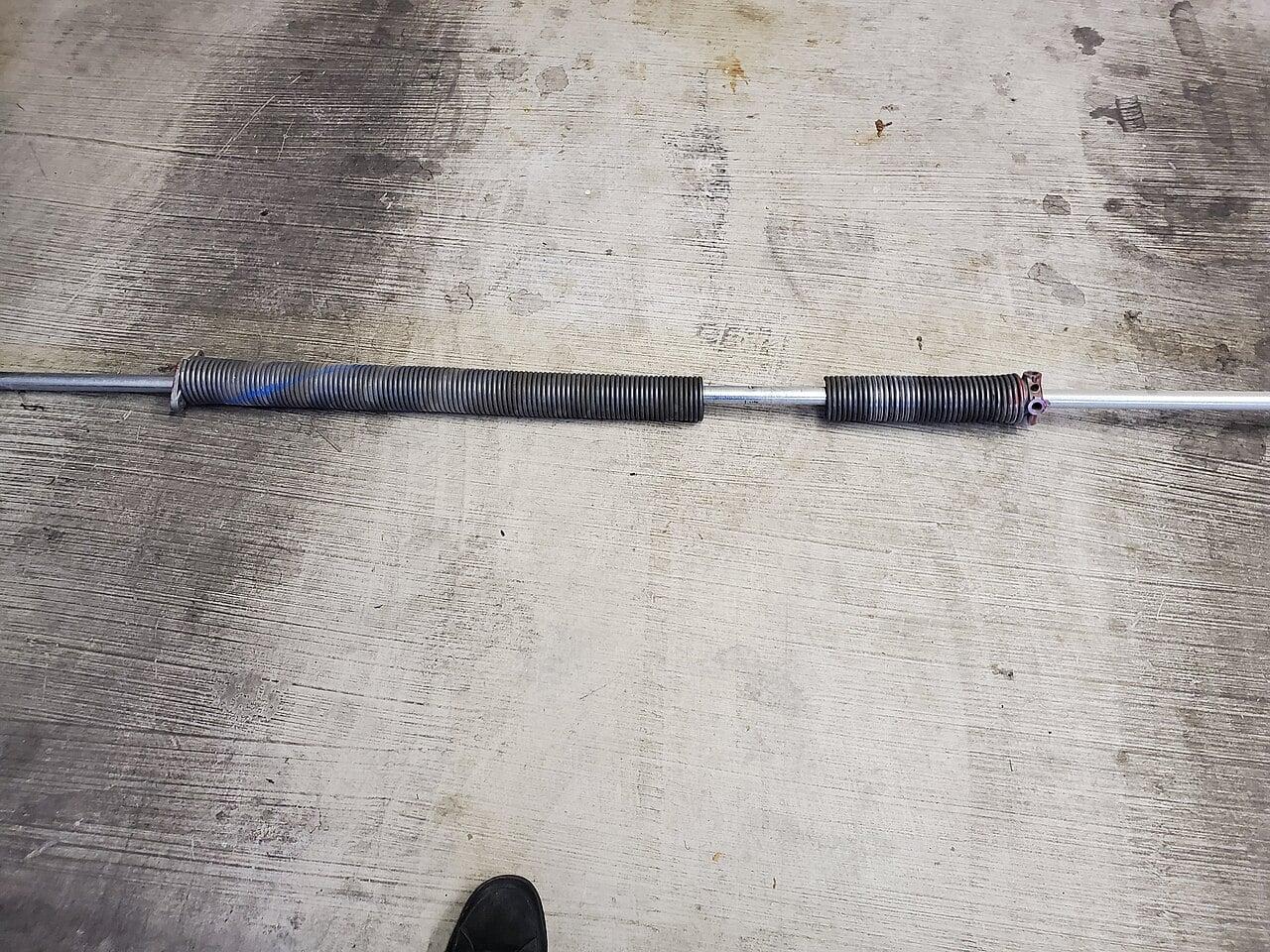
Changing the track geometry changes the moment arm on the torsion spring. A spring that balanced the door on standard-lift will either be too light (door crashes down) or too heavy (door flies up) once the track goes vertical. The spring must be recalculated for the new lift geometry, the drum circumference, and the actual door weight — which may have changed if insulation or windows were added since the original install. We weigh the door, measure the new track layout, and spec a spring that balances the door at 10 to 15 percent overbalance so it seats at the floor but does not require two people to pull down.
Cable drums and cables
Standard-lift drums have a constant-radius groove. High-lift and vertical-lift drums use a tapered or multi-radius groove that pays out cable at a changing rate as the door rises. Using the wrong drum makes the cables go slack at the top of travel or bind at the bottom. Both fail fast. The lift cables themselves are usually longer and sometimes a larger diameter to handle the increased fleet angle at the drum. We replace them as a set.
Operator considerations
A trolley operator mounted on the old horizontal track will not reach the new track location. Jackshaft operators (wall-mounted beside the torsion shaft) are the cleanest solution for high-lift and vertical-lift doors — they free the ceiling entirely and couple directly to the shaft. If you keep a trolley unit, it must be remounted on a new horizontal track section or a ceiling-mounted bracket, and the rail length must match the new door travel. Limit switches and safety reverses need full reprogramming.
When conversion is not worth it
- The door sections are delaminated, rusted through at the bottom, or have cracked stiles. You are putting new hardware on a failing curtain.
- The building cannot meet the headroom or sideroom minimums without structural work that exceeds the cost of a new door sized for the available space.
- The door is a lightweight residential-grade section on a commercial opening. It will bow under its own weight when stored vertically.
- The spring cycle life is unknown and the shaft, bearings, or cones show wear. A conversion is the wrong time to reuse tired hardware.
- You need a fire-rated assembly. Conversions void the listing unless the entire assembly is re-certified by the manufacturer.
In those cases, a new door built for the target track geometry — with the correct spring, drums, and operator from the factory — costs less in labor and eliminates the liability of a field-modified assembly.
What the site visit looks like
We measure the opening, the clear ceiling height, the sideroom, the roof deck condition, and the existing spring and drum specs. We weigh the door. We check the shaft diameter and bearing centers. We ask what you are putting in the space the track currently occupies — racking, a lift, a mezzanine — because the answer determines whether high-lift or full vertical-lift is the right call. You get a written scope: parts list, labor hours, lead time on any special-order track or drums, and a go/no-go on the existing panels.
Next step
If you are planning racking or a lift and need the track out of the way, call (604) 206-5727. We will look at the door, the building, and the layout and tell you straight whether a conversion makes sense or a new door is the better spend.