Most commercial doors ship with hardware rated for 25,000 cycles. At ten cycles a day that is seven years. At fifty cycles a day it is sixteen months. The upgrade path is not a single part — it is a matched set of springs, rollers, hinges, track, and cable that all share the same cycle rating. Miss one and the weakest link sets the real interval.
What 100,000-cycle hardware actually changes
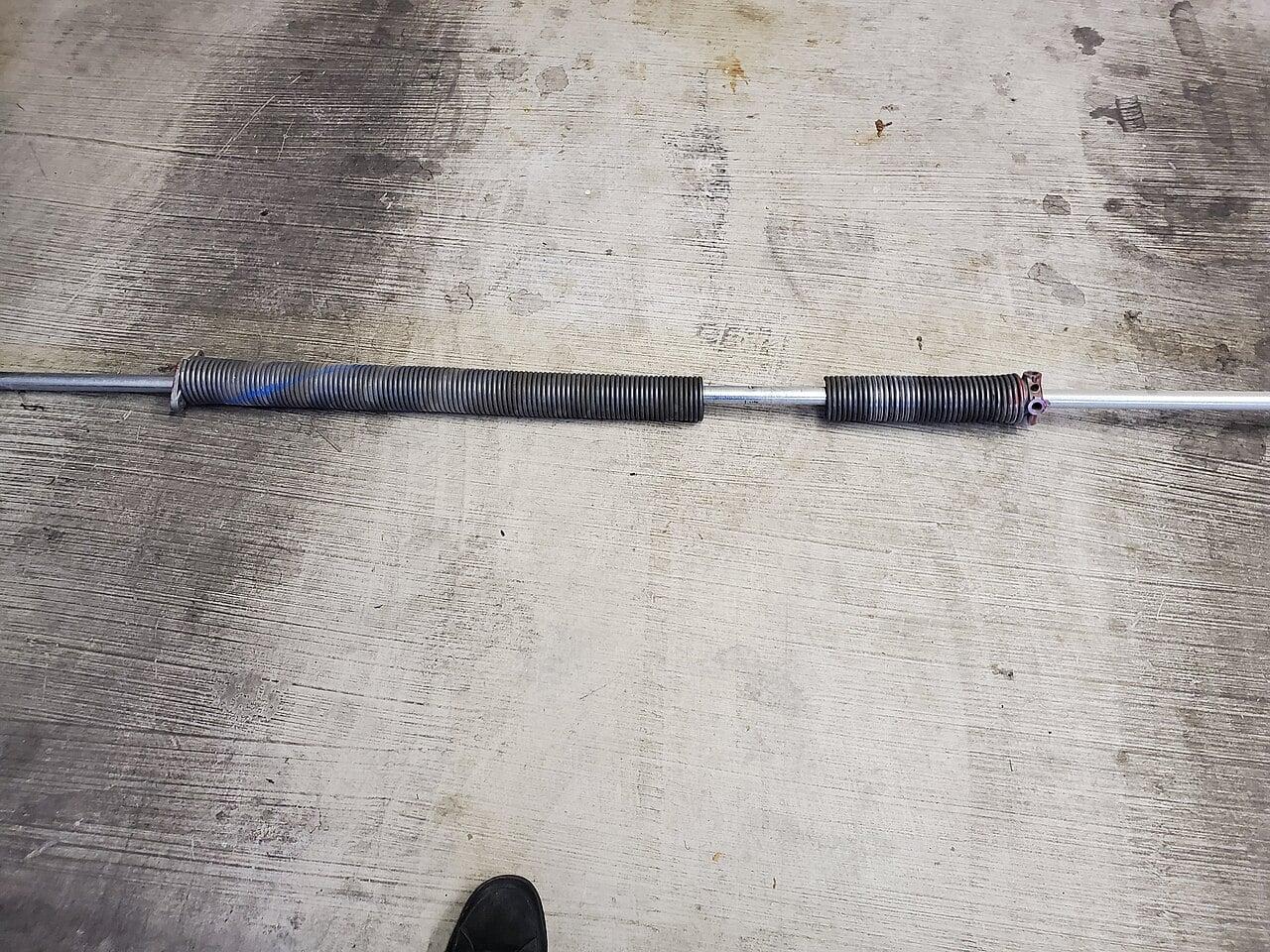
A standard torsion spring is wound for 25,000 cycles. The high-cycle version uses larger wire diameter and more active coils so the stress per cycle drops. The spring body gets longer. You need the headroom to fit it. If the shaft centerline is tight to the header, you either raise the shaft or accept a shorter spring life — there is no workaround.
Rollers are the next failure point. Ten-ball nylon rollers with unsealed bearings last 20,000 to 30,000 cycles in a dirty dock. Thirteen-ball precision bearings with full-contact seals and a hardened race push past 100,000. The stem diameter stays the same so they drop into existing hinges, but the hinge itself must move up a gauge or the roller outlives the leaf.
Hinges and the gauge jump
Fourteen-gauge hinges are standard on 2-inch commercial track. Eleven-gauge is the high-cycle step. The wider leaf spreads the load across more roller-stem surface and resists the elongation that lets the roller walk sideways. On doors over 14 feet wide you add a center hinge line — two hinges per panel joint instead of one — so each hinge sees half the cycles.
Strutting the top panel does not increase hinge life directly, but it keeps the panel flat. A bowed top panel loads the outside hinges unevenly and kills them early. Two 3-inch C-struts across the top section are cheap insurance.
Track: heavier gauge, wider spacing
Standard 2-inch track is 0.075-inch wall. High-cycle track is 0.105-inch. The thicker wall resists the peening that happens where the roller hits the same spot every cycle. You also widen the vertical track spacing from 12-inch to 15-inch centers on doors over 16 feet. Fewer clips, less flex, less roller side-load.
Horizontal track gets the same gauge bump. The critical detail is the splice plate. A four-bolt splice with a 12-inch overlap keeps the joint from stepping under repeated impact. Step the joint and the roller hammers it every pass — track fatigue follows fast.
Cables and drums: the matched pair
Cable diameter does not change — 3/16-inch or 1/4-inch aircraft cable is standard. What changes is the drum. A high-cycle drum has a larger root diameter and a wider groove. The cable wraps at a gentler bend radius so the wires do not work-harden and snap at the drum. You also gain wrap capacity, which matters on high-lift or vertical-lift conversions where the cable pays out farther.
If you upgrade the spring without the drum, the cable still sees the same bend radius. The spring lasts longer; the cable does not. Replace both.
Bottom brackets and operator arms
The bottom bracket takes the full cable tension plus the impact of every close. A forged 11-gauge bracket with a reinforced cable anchor outlasts the stamped 14-gauge version by a factor of three. On doors with jackshaft operators, the drive arm and coupler see the same cyclic load. A splined coupler with a hardened insert replaces the standard keyed version and eliminates the wallow that eventually rounds the keyway.
Weather and contamination
Salt, dust, and coolant mist accelerate wear on every bearing surface. Sealed rollers and sealed bearing blocks on the shaft buy real time in those environments. Grease fittings on the shaft bearings let you flush contamination without pulling the shaft. On a 20-foot door that is a two-hour job versus a half-day teardown.
The upgrade list in order
1. Torsion springs — matched to door weight, cycle rating, and available headroom 2. Cable drums — high-root, wide-groove, matched to the new springs 3. Rollers — 13-ball sealed precision, nylon tire, 7/16-inch stem 4. Hinges — 11-gauge, double end hinges on wide doors 5. Track — 0.105-inch wall, 15-inch vertical spacing, four-bolt splices 6. Bottom brackets — forged 11-gauge with reinforced anchor 7. Shaft bearings — sealed pillow blocks with grease fittings 8. Operator coupler — splined hardened insert (jackshaft only)
Do them all at once. Doing springs and rollers but keeping 14-gauge hinges means the hinges fail at 35,000 cycles and you are back on a lift. The labor to swap hinges later is the same as doing them now — you just pay the mobilization twice.
When to spec it on a new door
Any door hitting 30 cycles a day — two shifts, loading dock, parkade with tailgate traffic — should ship with the high-cycle package. The material uplift is roughly 35 percent over standard hardware. The labor is identical. The first avoided spring change pays the difference.
Retrofit on an existing door makes sense when the door body is sound but the hardware has already turned once. If the panels are cracked, the track is bent, or the shaft is scored, fix the structure first. High-cycle hardware on a damaged door is money burned.
What the operator sees
A door that used to need spring service every eighteen months goes three to five years. Roller replacement drops from annual to once a decade. The emergency call at 6 a.m. because a cable snapped on the first truck — that stops. The door still needs lubrication and inspection. But the interval stretches from reactive to planned, and that is where the budget lives.
Call (604) 206-5727 — Metro Vancouver.