It's 9 p.m., the last staff member is leaving, and the bay door won't come down. Before anyone pulls a release handle, here's what the operator manuals say about getting it closed safely, and when it's time to call for emergency service.
A commercial garage door stuck open after hours is a security problem first and a repair problem second. The goal tonight is to get the opening closed without making things worse. With a commercial operator, there’s often a safe way to do that. There’s also one move the manuals warn against.
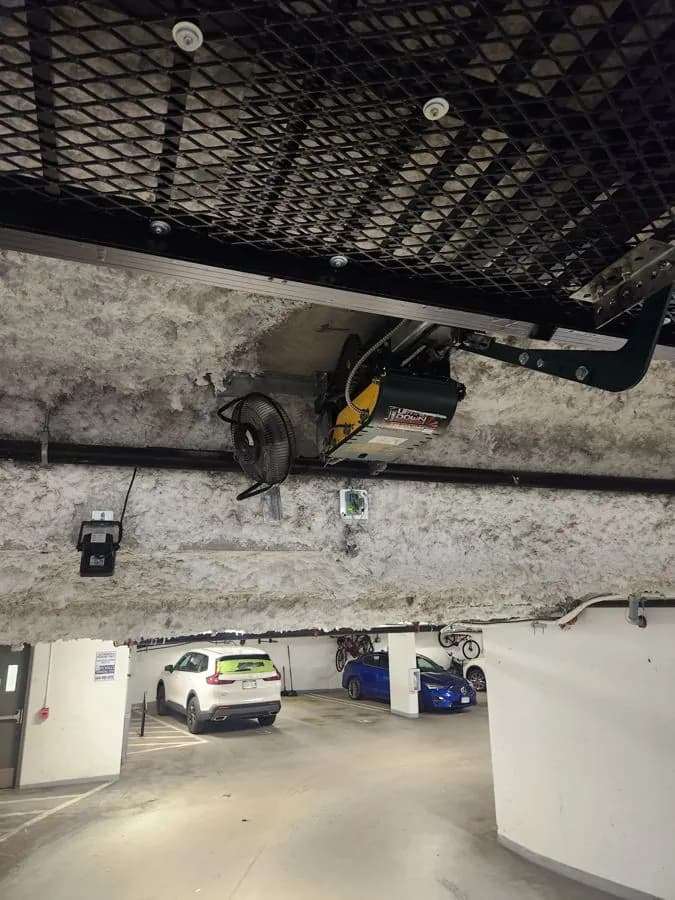
Commercial garage door stuck open? Step 1: find out why
The door’s behaviour tells you most of what you need. Try the close button once and watch.
| What you see | Most likely cause | Where to go next |
|---|---|---|
| Door starts down, then reverses back up | Photo eye or sensing edge blocked, misaligned or faulted | Step 2 |
| Door only moves while you hold the button | Operator has fallen back to constant pressure to close | Step 2 |
| Nothing happens at all, no hum | Power off, hoist or disconnect engaged, control fault | Step 3 |
| Motor runs but the door doesn’t move | Drive problem, or the door is disconnected | Call. Don’t force it |
| Bang, then the door won’t move or hangs crooked | Broken spring or cable | Call. Keep everyone clear |
Step 2: If the safety system is stopping it
Check the obvious first: a pallet, a bin, snow or a wet leaf on the photo eye lens, or a bumped sensor bracket. Clear it and try again.
If the door still won’t close normally, many commercial operators give you a lawful way to close it under supervision. LiftMaster’s Logic 5.0 manual explains that without a working monitored entrapment protection device, constant pressure to close is required from the control station. Hold the close button and the door travels down. The manual also describes a Restricted Close feature: when the door is stopped part-way and a monitored device or edge input is active, pressing and holding close starts the door down after 5 seconds. MAXUM DC operators allow an activated monitored device to be overridden with 5 seconds of constant pressure on the close button. Manaras BOARD 070 says that if the monitored device or loop input stays activated, the door can be closed by constant pressure on the close button.
Whoever holds the button must be able to see the whole opening and stop the moment anything is in the way. That’s the point of constant pressure. Our article on why a LiftMaster door only closes on hold explains the LEDs and what to check in daylight.
Do not bridge, tape or re-aim a photo eye to “fix” it. That defeats the only thing protecting people and vehicles at the door.
Step 3: If the operator is dead
Check whether the hoist or disconnect is still engaged
Many jackshaft operators have a chain hoist for manual operation, and an interlock that cuts the electrical controls while it’s engaged. On LiftMaster’s H, GH, J and HJ models the manual says the electrical interlock disables the controls when the hoist is used. The disconnect (sash) chain has to be released from its chain keeper before the door will run electrically again. Manaras describes the same interlock on its hoist-equipped models. A door someone hand-chained up at noon, with the hoist left engaged, will look “dead” at 9 p.m. for exactly this reason.
Manaras’s technical data book also lists a hoist that didn’t return to position. Their fix is to pull the hand chain about a foot the opposite way so the hoist returns and the disconnect switch closes.
Hand-chain it closed, if it has a hoist
If power is out or the operator has failed, a door with a chain hoist can usually be cranked down by hand. LiftMaster’s instruction for these models: disconnect electric power to the operator before operating the door manually, to avoid injury from a moving chain. Manaras notes on its MGH sheet that the hoist is designed for light, limited use, for troubleshooting only. That’s fine for closing up tonight, but not a way to run the door for a week. Our chain hoist guide walks through it, and the power outage guide covers doors without a hoist.
The one thing not to do: pull the release on an open door
On trolley-type operators (the kind with a rail down the middle of the ceiling), the instinct is to pull the red release and drag the door down. The LiftMaster manual is blunt about it. Use the manual release to disengage a door only when the door is closed, if possible, because weak or broken springs or an unbalanced door could make an open door fall rapidly and unexpectedly, causing severe injury or death. It also says never to use the release unless the doorway is clear, not to stand under the door arm when pulling it, and that no one should go under a stopped or partly open door.
A door that’s stuck open because a spring broke is exactly the door that will fall when released. If you heard a bang, or the door sits crooked or one cable hangs slack, leave it up, block off the area, and call.
Securing the building if the door can’t be closed
- Keep people and vehicles out from under the door with cones or tape.
- Secure what’s behind it: lock interior doors, move high-value stock, tell your alarm company the zone is open.
- Make a note of the make and model on the operator label, any blinking LEDs, and what the door did. A dispatcher can send the right parts with that.
- Take photos if a vehicle or forklift was involved. You’ll want them for insurance.
When to call our 24/7 line
Call now if a commercial garage door stuck open won’t close by any of the methods above and the opening can’t be left, if there’s any sign of a broken spring or cable, if a vehicle hit the door, or if the door is off its track. CCGDS answers commercial door emergency calls 24/7. Our 24 hour commercial garage door repair page covers how call-outs work across Metro Vancouver, and the emergency repair page explains what to do before the technician arrives.
If the door closed under supervision and is secure, book a normal visit for the morning to find out why the safety system or operator failed. A door that only closes while someone holds the button will do it again.
Questions property managers ask us
Can I pull the emergency release to get an open commercial door down?
Not if you can avoid it. LiftMaster’s manual says to use the manual release only when the door is closed, because weak or broken springs or an unbalanced door can make an open door fall rapidly and unexpectedly.
The door reverses every time I try to close it. How do I get it down tonight?
Clear and check the photo eyes first. If it still reverses, many commercial operators let you close by holding the close button down with constant pressure while you watch the opening. On LiftMaster MAXUM DC operators, 5 seconds of constant pressure overrides an activated monitored device.
Why is the operator completely dead after someone used the chain?
Hoist-equipped operators have an electrical interlock that disables the controls while the hoist is engaged. On LiftMaster H, GH, J and HJ models the disconnect chain must be released from its chain keeper before the door will run electrically again.
Is it safe to keep running the door on the hand chain?
It is fine for getting the door closed, but Manaras says its hoist is designed for light and limited use in troubleshooting. Turn off power to the operator first, and book a repair rather than running the door by hand for days.
When is a stuck-open door an emergency?
When it won’t close by any safe method and the opening can’t be left, when a spring or cable looks broken, after a vehicle strike, or when the door is off its track. Those warrant a 24/7 call.
Book a look at your doors
Call (604) 206-5727 or use the contact page. We answer around the clock for commercial door failures. New commercial clients: 10% off labour on your first service call or repair. Mention NEW10 when booking (one per business, not combinable with maintenance-contract pricing, work booked by Dec 31, 2026).

