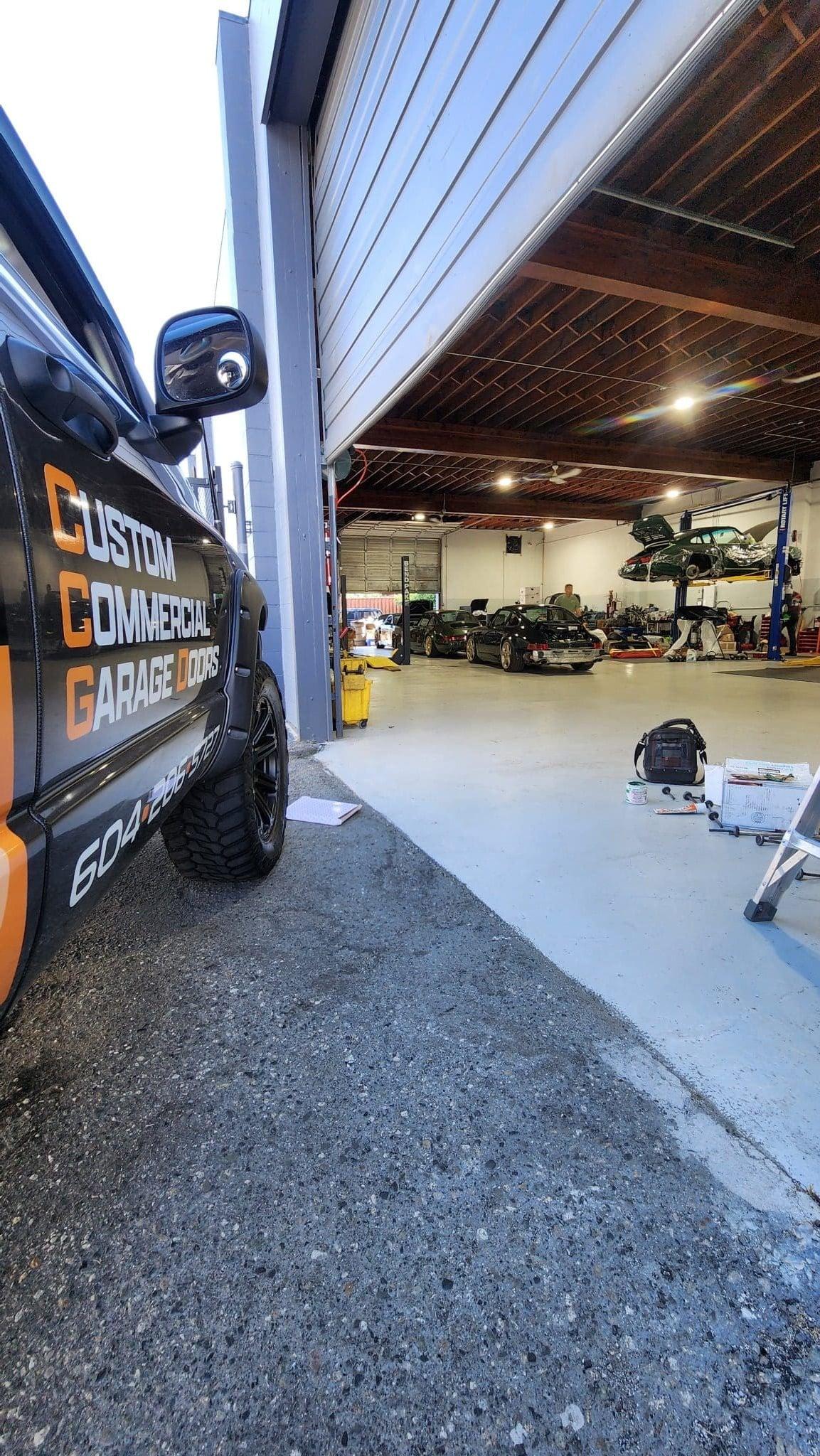
Around here people say bay door for almost any big commercial door. The sectional over a loading dock, the rolling steel on a shop bay, the high-lift door a forklift clipped last week. We handle bay door repair Vancouver wide and across the rest of Metro Vancouver. This page explains what actually breaks and what we check first. It also covers what a realistic same-day fix looks like.
Around here people say bay door for almost any big commercial door. The sectional over a loading dock, the rolling steel on a shop bay, the high-lift door a forklift clipped last week. We handle bay door repair Vancouver wide and across the rest of Metro Vancouver. This page explains what actually breaks and what we check first. It also covers what a realistic same-day fix looks like.
What counts as a bay door
Bay door is a job-site word, so callers mean different hardware. Most of the time it is one of three builds. A commercial sectional, like the Amarr commercial line we stock and install, with torsion springs on a shaft above the opening. A rolling steel door that coils into a barrel. Or a high-lift or full-vertical sectional in a shop with tall ceilings, usually driven by a jackshaft operator on the wall.
The build matters because the same symptom points at different parts. A sectional that drops crooked usually has a snapped lift cable. A rolling steel door that will not budge often has a dead counterbalance spring sealed inside the barrel, which is a bigger job than it sounds. We ask what the door looks like before we roll a truck so the right parts come with it.
The failures we see most on Metro Vancouver bays
After enough dock calls between Mitchell Island and Port Kells you stop being surprised. The list barely changes.
- Snapped or frayed lift cables. The door hangs cocked in the opening or sits jammed two feet up. Our cable repair page covers this one in detail. Cables fail at the bottom bracket where road salt and dock grime collect.
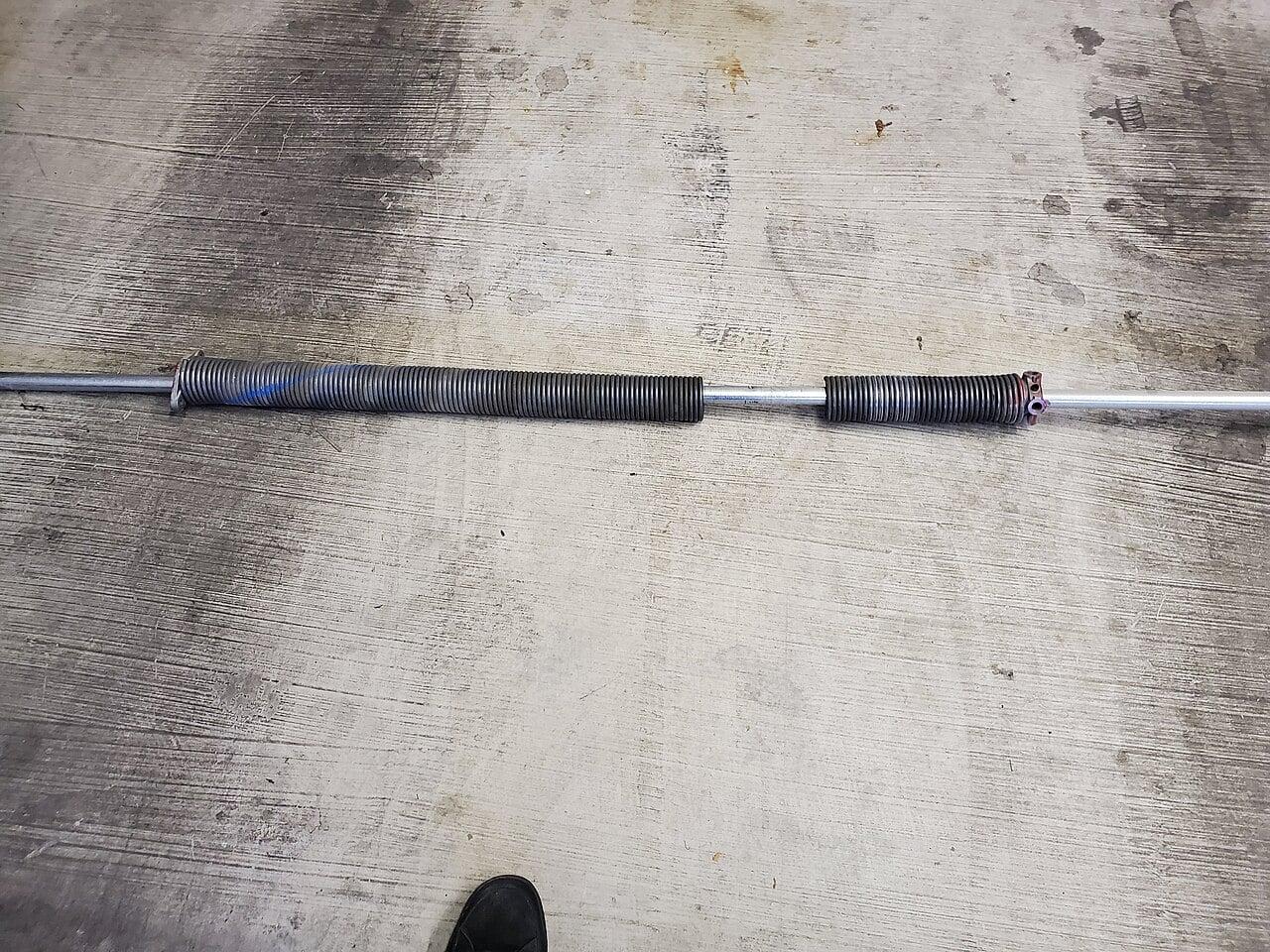
- Broken torsion springs. One loud bang, then the operator strains and quits or the door is suddenly too heavy to lift by hand. Springs are rated in cycles, so a busy dock door burns through them far faster than the quiet bay beside it.
- Vehicle and forklift impact. Bottom sections, bent track, sheared track brackets. Trailers back into door frames. Forklifts catch the bottom bar on the way out. Most dock damage we repair comes down to wheels or plain wear.
- Operator faults. Stripped sprockets, worn clutches, limit switches that drift until the door slams the floor or stops a foot short.
- Photo eye and safety edge failures. The door reverses for no visible reason, or will only close while someone holds the button. Under UL 325 a commercial operator in momentary contact mode needs working entrapment protection. Bypassing the eyes is the wrong answer even when a wash-down knocked them crooked.
Why a bay door fails differently than a front-of-house door
A storefront sectional might run six cycles a day. A distribution dock door on Annacis Island can run sixty. LiftMaster rates its industrial Logic 5.0 operators at 25 cycles per hour and up to 90 per day. Its MAXUM DC line goes to 30 per hour and 150 per day in extended duty. Those numbers tell you how hard manufacturers expect these doors to work. Hardware sized for light duty on a heavy bay is the single most common root cause we find.
High-lift and vertical-lift bays carry an extra wrinkle. DASMA Technical Data Sheet 1501 warns that jackshaft operators on standard lift track can let the cables go slack near the open position. Slack cables can jump the drum and drop a door. Its recommended fixes include cable keepers, cable tension monitoring, slower door speed and doors built to the ANSI/DASMA 102 sectional door specification. When we repair a jackshaft-driven bay we check cable tension at full open every time. A repair that leaves slack cables is just the next failure on a timer.
There is also a legal layer in BC. Section 4.3 of the WorkSafeBC OHS Regulation requires workplace equipment to be capable of safely performing its function. The same section requires it to be used and maintained in line with the manufacturer’s instructions. A dock door is workplace equipment. A broken one that staff keep forcing is the kind of detail an officer notices after an incident.
What we check before touching the broken part
The obvious broken part is not always the cause. A cable that snapped at 9 am often snapped because a spring lost tension months ago and the cable has carried the imbalance ever since. So the first ten minutes on site follow the same order on every truck.
The order of operations on site
- Disconnect the operator and lift the door by hand. Balance tells us whether springs still carry the weight.
- Walk both cables, drum end down to the bottom bracket, looking for frays and flat spots. Check the drum wraps sit in sequence too.
- Sight down the track for bends and spread. Then check the brackets are not pulling out of the jamb. Impact damage hides above the opening where nobody looks.
- Check rollers and hinges at the section joints. One seized roller loads every part downstream of it.
- Run the operator through a full cycle and watch the limits and the clutch. Test the entrapment devices on the same run.
Only then does a part get replaced. It takes a few extra minutes and it is the difference between a repair and a return visit.
Bay door repair Vancouver businesses can actually schedule
Same-day is realistic for the common failures when the truck carries the parts. Our dispatch matches the call to the nearest technician carrying the right stock for that repair type. That is how spring and cable jobs get closed in one visit. From our Richmond shop on River Rd we reach most Richmond industrial areas in 30 to 45 minutes during business hours. The phone is answered around the clock, 2 am on a stat holiday included. Our 24/7 emergency repair page covers the after-hours side. If the door failed in the open position, our guide to a commercial door stuck open after hours walks through securing the bay overnight.
What is not realistic same-day. Full sections for a specific panel profile and colour sometimes have to come from the manufacturer. So do complete rolling steel curtains and custom-length barrel springs. In those cases we make the opening safe and secure first. Then we order the part and book the return. Nobody enjoys that conversation, so we have it on the first visit rather than after a week of silence.
Keeping the bay working until we arrive
A few things help and a few make it worse. Do keep people and forklifts away from a door hanging crooked in the opening. A sectional with one snapped cable is held by the other cable and not much else. Do lock out the operator if staff keep hitting the button on a jammed door, because a straining operator bends track and strips sprockets. Do take a photo of the door and text or email it when you book, since it changes what goes on the truck.
Leave anything attached to the spring shaft alone. No cutting, no unbolting. Torsion springs on a loaded shaft store enough energy to break an arm, and winding them is a job for a trained tech with proper winding bars. Do not back a trailer against the door to hold it shut overnight. We have repaired the second round of damage that trick causes more than once.
For bays that fail on a schedule, which usually means high-cycle doors that never see service, a standing program catches springs and cables before they let go. Our warehouse door service and maintenance page explains how we set those up. The loading dock safety inspection guide covers the leveler and restraint side of the same dock.
Bay door repair Vancouver wide, Richmond to Langley
Custom Commercial Garage Doors is commercial only, based at 7080 River Rd in Richmond. We run calls across Vancouver, Burnaby, Surrey, Delta, Richmond, New Westminster, Coquitlam, Langley and the North Shore. Dock door on Clark Drive, shop bay in Port Kells, parkade gate in a Burnaby strata, same crew. Loading dock doors specifically get their own treatment on our loading dock door repair page.
If a bay is down right now, call (604) 206-5727. The call gets answered and the details get captured. Then the nearest tech with the right parts gets dispatched. A dead bay door costs a working building money every hour it stays shut.