The gap at the bottom of a 14-foot warehouse door moves more air than an open window. It also lets in rain, rodents, and the cold that makes forklift batteries die in January. Sealing it properly is not a single product — it is a system matched to the door type, the floor condition, and what actually passes through the opening.
Why the perimeter fails first
Overhead doors are built to move, not to sit tight. A sectional door flexes at every hinge. A rolling steel curtain bows under wind load. The header shifts when a trailer bumps the dock leveler. Every cycle works the seal loose.
The most common failure points appear in the same order on every job:
Bottom seal. The rubber astragal hardens, splits, or tears on the leading edge. On a dock door, the beveled bottom edge of a trailer shears it off in one bad approach.
Side jambs. Brush or vinyl weatherstrip loses its memory. It either pulls away from the face of the door or gets shredded by a pallet jack corner.
Header. The top seal — usually a brush or a vinyl flap — gets compressed flat after a few thousand cycles. Once it stops springing back, the gap stays open.
Threshold. The concrete floor is rarely flat under the door. A 1/4-inch dip across 12 feet leaves a continuous leak no jamb seal can close.
Sectional doors: seal the face, not just the edge
On a standard-lift sectional, the door panels press against the jamb face when closed. That gives you a flat sealing surface — if the jambs are plumb and the floor is level.
Bottom astragal. Use a U-shaped rubber bulb rated for the door width, not a generic roll cut to length. The bulb compresses against the floor and fills minor low spots. Replace the retainer channel if the slots are wallowed out; a loose retainer lets the seal slide sideways and tear.
Jamb seals. Vinyl bulb seals (often called “stop molding”) nail or screw to the wood or steel jamb. The bulb compresses against the door face. Install with the bulb slightly compressed at rest — about 1/8 inch — so it stays in contact through the door’s natural bow.
Header seal. A rigid vinyl flap mounted to the header, sweeping the top panel. It must clear the torsion shaft and cables. On high-lift tracks, the header seal mounts on the horizontal track angle instead.
Threshold seal. If the floor has a dip wider than the bulb can bridge, glue a rubber threshold strip to the concrete with polyurethane adhesive. The door closes on top of it. This is the only reliable fix for a sunken approach slab.
Rolling steel doors: the curtain moves differently
A rolling door curtain hangs in vertical guides. It does not press flat against a jamb. The seal has to work against the edge of the curtain or the face of the guide.
Guide weatherstrip. Brush seal (nylon or polypropylene filament) mounts inside the guide angle, sweeping the curtain face. It handles the curtain’s lateral movement better than vinyl. Spec the filament length to the curtain gauge — 22-gauge curtain needs shorter filament than 18-gauge.
Bottom bar seal. The bottom bar gets a rubber astragal in a retainer slot, same as a sectional. But the bottom bar often hits the floor at an angle if the guides are out of plumb. Check guide alignment before replacing the seal.
Hood baffle. The coil hood is a chimney. A brush baffle across the hood throat stops the stack effect. It mounts to the hood interior with self-tappers. Do not skip this on conditioned spaces.
Dock doors: abuse is the design condition
A dock door sees trailer impact, ice buildup, salt, and 20 cycles an hour. Standard vinyl lasts two weeks.
Heavy-duty bottom seal. Double-bulb rubber astragal in a steel retainer channel, bolted (not tekked) to the bottom panel. The second bulb acts as a backup when the first tears.
Armored jamb seals. Steel-backed rubber or UHMW polyethylene strips that bolt to the jamb face. A forklift tine glances off them instead of peeling the seal away.
Inflatable dock shelters. For temperature-critical openings, the shelter seals against the trailer, not the door. The door seal becomes secondary. Maintain the shelter curtains and the inflator fan — a deflated shelter leaks more than an open door.
Threshold plates. Steel plate welded or bolted to the concrete, sloped to shed water. The door closes on the plate. It survives impact that destroys rubber thresholds in a single shift.
Floor flatness is the variable you cannot seal around
No perimeter seal compensates for a floor that drops 3/4 inch across the opening. The door will either bind on the high side or gap on the low side.
Check with a 6-foot level before you quote the job. If the floor is out, the options are:
- Grind the high spots (dusty, slow, only works for minor crowns)
- Self-leveling patch under the threshold area (fast, holds if prepped)
- Custom threshold fabricated to match the floor profile (expensive, permanent)
- Adjust the door travel limits so the bottom bar seats on the high side and the threshold seals the low side (compromise, requires operator reprogramming)
Tell the customer the truth: a seal on a bad floor is a maintenance item, not a fix.
Cold storage and freezer doors
Standard vinyl and brush stiffen below freezing. The seal becomes a rigid plastic strip that leaks air and snaps on the first cycle.
Use silicone-bulb seals rated to -40°C. They stay flexible. The retainer channels must be stainless or aluminum — mild steel rusts, expands, and jams the seal.
Header seals on freezer doors need a heated circuit or a double-flap design to prevent frost lock. A single vinyl flap freezes to the top panel overnight. The operator either rips the seal or trips the force limit.
Inspection checklist (quarterly, minimum)
1. Bottom astragal — intact, flexible, retaining clips present 2. Jamb seals — full contact top to bottom, no daylight at corners 3. Header seal — springs back when pushed, clears hardware 4. Threshold — bonded, no gaps at ends, no tripping hazard 5. Guide brush (rolling doors) — filament not matted or missing 6. Hood baffle — in place, not melted by lighting fixtures 7. Operator force limits — verified after any seal replacement
A seal change alters the closing force. Always re-test the safety reversal.
When to call a commercial door company
- The door is out of level and you cannot shim the track enough
- The floor needs grinding or patching before a threshold will hold
- You need fire-rated seals on a labeled opening (UL 10B / NFPA 80)
- The opening is wider than 20 feet — standard retainer channels bow
- You are retrofitting a dock shelter and need the door coordinated with it
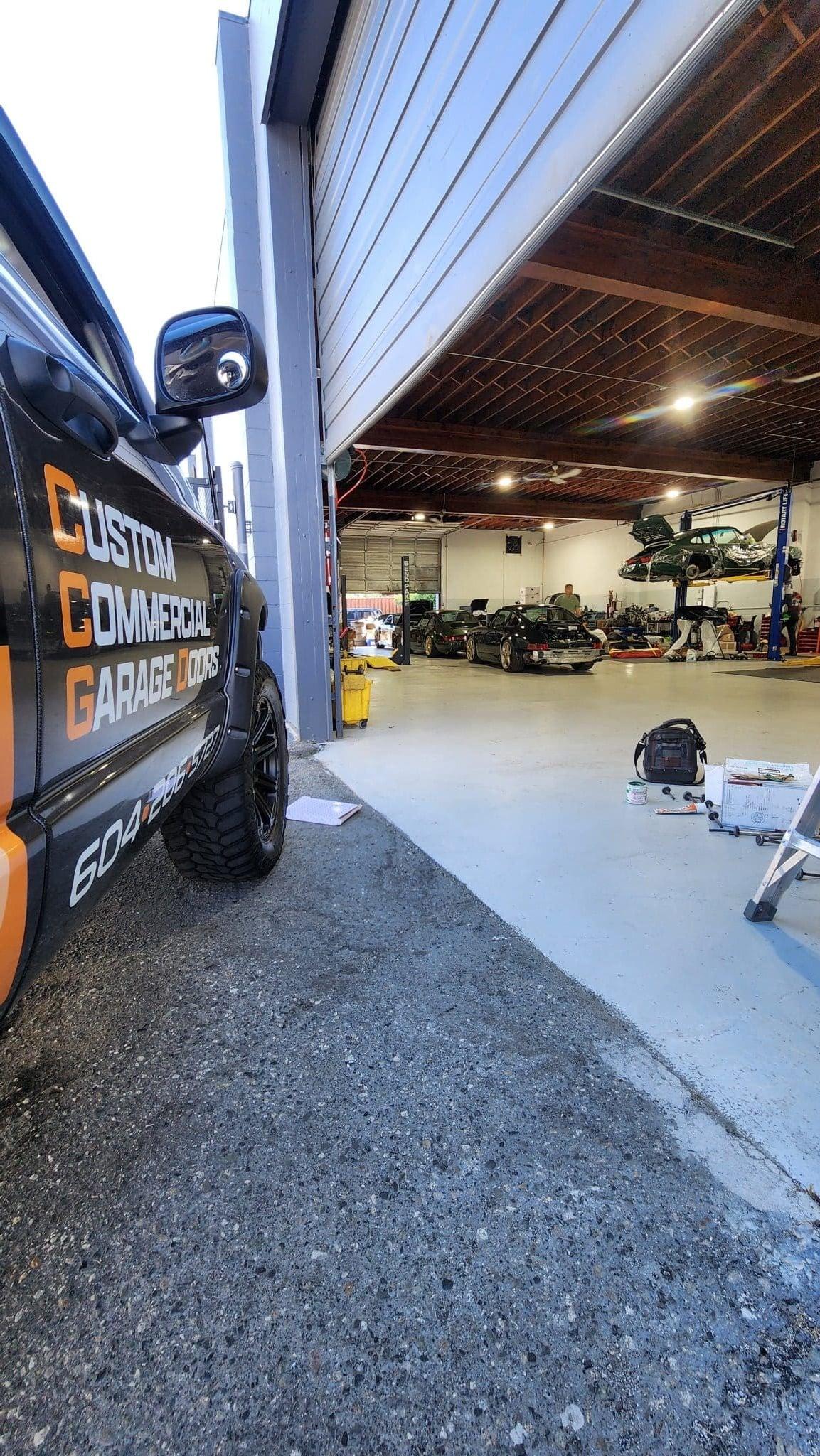
CCGDS works on sectional, rolling, and dock doors across Metro Vancouver. We carry Amarr, Raynor, LiftMaster Maxum, Manaras, and Hörmann parts in stock for the seals and hardware listed above.
Call (604) 206-5727 — Metro Vancouver.