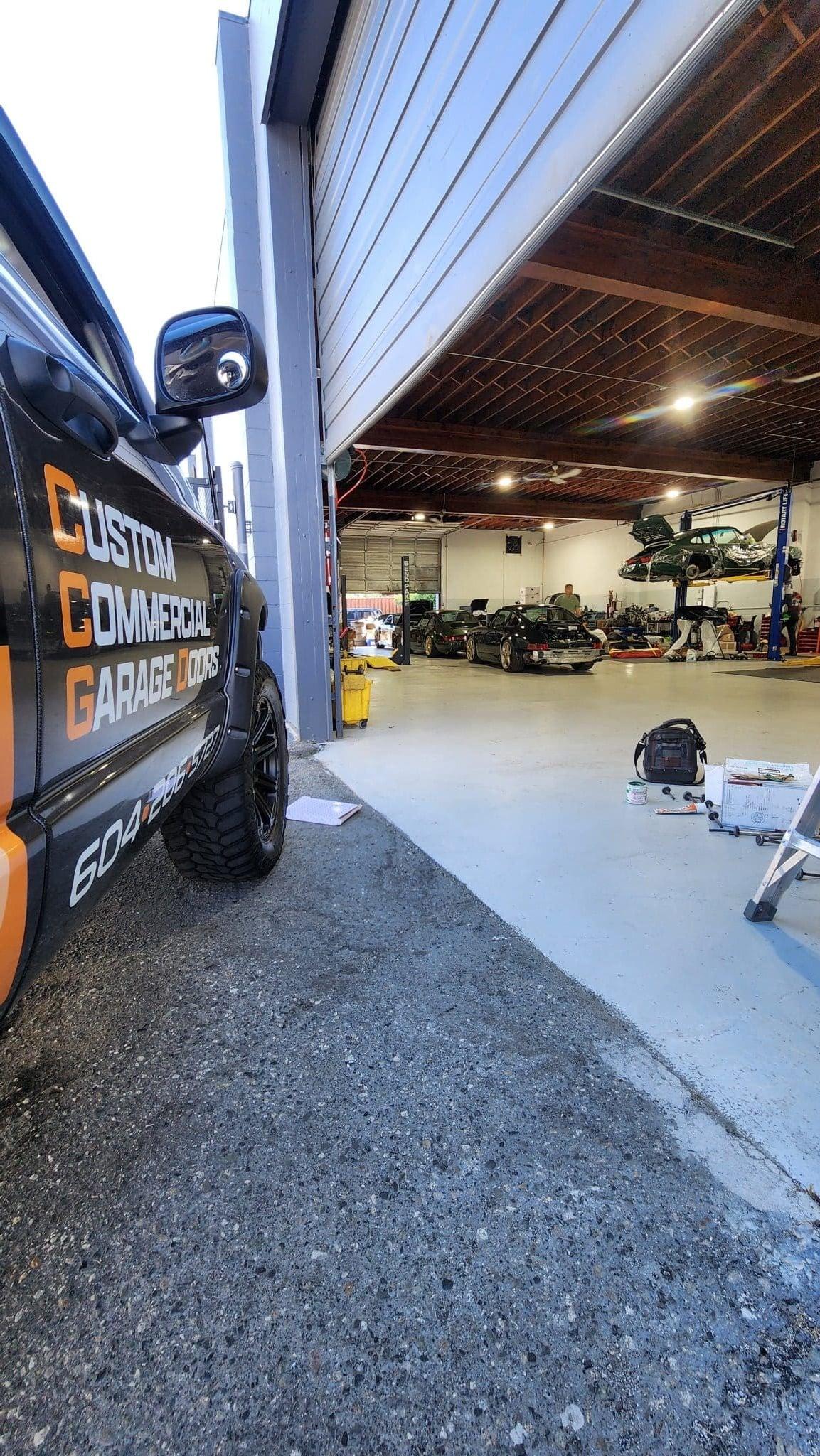
Most door companies draw a hard line at 16 feet high. Once the opening exceeds standard sectional dimensions — whether it’s a 24-foot crane bay, a 30-foot hangar door, or a custom bi-fold on a marine yard — the parts catalogs run out and the liability conversation starts. That is usually when the facility manager starts calling around and hearing “we don’t do those.”
The difference isn’t the door. It’s the hardware that carries the weight, the track geometry that handles the lift, and the operator that can start and stop that mass without tearing the header off the wall.
Why standard sectional logic fails at scale
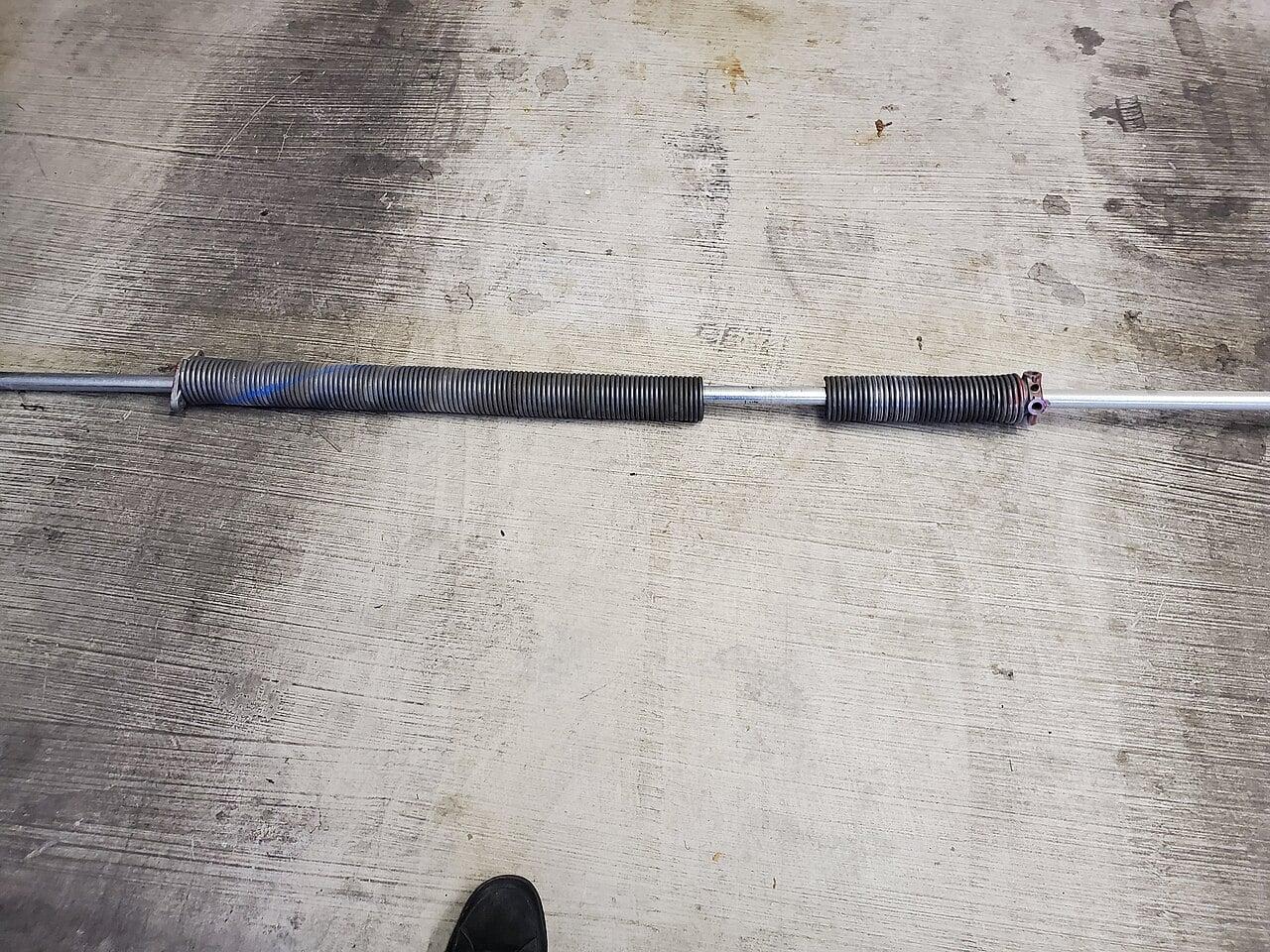
A 14-foot residential sectional and a 24-foot crane-bay door look similar in photos. In the field they share almost nothing. The torsion spring on a standard door stores enough energy to break an arm. The spring pack on a 24-foot door stores enough to kill you if the winding bar slips — and the cones, shafts, and center brackets are sized accordingly. You don’t wind those with a pair of 18-inch bars and a cheater pipe. You need a calibrated torque wrench, a spring calculator that accounts for the actual wire diameter and coil count, and a second technician holding the other end of the shaft.
Track is the next failure point. Standard 2-inch track with 13-gauge verticals will deflect under a 2,000-pound door. At that width you’re running 3-inch track minimum, often with reinforced horizontal angles bolted to the building steel, not lagged to wood jambs. The radius matters too. A 15-inch radius on a 24-foot door puts the top section through the roof trusses. You need low-headroom or high-lift track designed for that specific opening, and the splice plates have to be welded or through-bolted, not pop-riveted.
Rollers are where the noise starts. Ten 2-inch nylon rollers on a standard door. Twenty-four 3-inch steel rollers with sealed bearings on a crane bay. When one seizes, the door binds, the cable slackens, and the next cycle jumps the drum. That’s how you get a door cocked sideways in the opening at 6 a.m. with a shift waiting to unload steel.
Operator sizing is not a suggestion
A 1/2 HP jackshaft operator will lift a 24-foot door once. The second cycle trips the thermal overload. The third strips the internal gear. Operators for oversized doors are sized by peak torque and duty cycle, not horsepower. A 2 HP Maxum or Manaras unit with a 30:1 reducer, brake module, and external limit switch is the minimum. The brake matters more than the motor — when the power cuts, a 3,000-pound door doesn’t stop because the motor quit. It stops because the brake held the drum.
Limit switches on big doors are not the plastic cam type. They’re rotary encoders or geared limit assemblies mounted on the shaft, calibrated in inches of travel. If the encoder slips one revolution, the door tries to close through the floor or open through the roof. We check calibration on every service call. It takes five minutes and prevents five-figure damage.
Cables, drums, and the physics of a bad day
Cable length on a 24-foot high-lift door exceeds 40 feet per side. That much 7×19 aircraft cable stretches under load. The drums are grooved for that specific cable diameter and lift type — standard lift, high lift, or vertical lift. Mix a high-lift drum with a vertical-lift cable and the door will bind at the transition point every time.
We carry 1/2-inch, 9/16-inch, and 5/8-inch cable in the truck, along with the matching drums. Most shops don’t. They order it. The door sits open for three days while the distributor ships from Ontario. That’s the practical difference: stock versus lead time.
The building structure is part of the door
A standard door hangs on jambs. An oversized door hangs on the building. The header beam, the spring anchor pads, the track brackets — all of it transfers load into the steel frame or concrete tilt-up. If the header has deflected an inch over ten years, the door will never seal. If the spring anchor bolts were drilled into hollow CMU instead of welded to a plate on the column, the first hard wind or the first cycle with a broken spring pulls the anchor out and takes the wall with it.
We’ve seen both. The fix isn’t a door part. It’s structural steel, welding, and sometimes an engineer’s stamp before the city will sign off. That work falls outside a typical door scope, but it falls inside the scope of getting the door to work. We coordinate it because the alternative is a door that operates for three months and then fails the same way.
Weather, wind, and the Lower Mainland reality
A 24-foot door in Richmond sees different physics than one in Calgary. The wind load here is lower by code, but the rain is constant. Water sits in the bottom seal groove, freezes overnight, and the door freezes to the floor. The operator tries to open, the torque limiter slips, and the limit switch thinks the door is closed when it’s still on the ground. Next cycle it tries to close again. The bottom section bows.
We spec bottom seals with a drain channel, not a flat bulb. We set the down limit 1/4 inch above the floor and let the seal compress. We lubricate the track with synthetic grease that doesn’t wash out in November. These are small decisions. They’re the reason the door still works in February.
What a service call looks like
You call. The voice AI picks up at 2 a.m., logs the location and symptom, and dispatches the nearest tech carrying the relevant spring wire, cable, or drum stock. That part — having the right diameter cable on the truck — is why the door gets fixed that day instead of next week.
On site, the tech doesn’t start with the opener. They start with the balance. Disconnect the operator. Lift the door by hand — or by chain fall if it’s a 3,000-pound section. It should stay where you put it at waist height. If it crashes down or flies up, the springs are wrong. That happens more than you’d think: a previous vendor installed the wrong wire size because it was on the shelf.
Then the track. Plumb, level, bolted to structure. Rollers spin freely. Cables seated in the drum grooves with no crossover. Limits calibrated. Brake tested under load. Safety edges and photo-eyes functional at full travel. The operator cycles three times under observation. If the door moves smooth and quiet, the job is done.
When replacement makes more sense than repair
Steel fatigues. A 25-year-old crane-bay door with original track, original springs, and three generations of patch-welded panels has a finite number of cycles left. Sometimes the honest answer is “this door has served its life.” We’ll say it. The replacement conversation starts with the opening dimensions, the headroom, the sideroom, the building structure, and the duty cycle — not a catalog page.
Amarr builds custom sectional doors to 30 feet wide and 24 feet high in 1-inch increments. Hörmann builds larger. Both can be insulated, fire-rated, or glazed. The lead time is six to eight weeks. In the meantime, we can usually keep the old door limping along with targeted repairs — cable, roller, spring — so the bay stays productive.
The question to ask before you hire
If the answer is no, keep calling. The physics doesn’t care about the company name on the truck. It cares about the torque on the winding bar, the cable on the drum, and the brake on the operator. Those are the details that decide whether the door opens tomorrow morning.
Call (604) 206-5727 — Metro Vancouver.