The short answer: an overhead door is not an exit door unless it is built, labelled, and hardware-equipped as one. Most are not. The BC Building Code treats egress and overhead doors as separate categories, and the distinction decides whether your staff can legally leave through that opening in a fire.
What the Code Calls an Exit
Article 3.4.2.1 of the BC Building Code defines an exit as “that part of a means of egress… that leads from the floor area it serves to a public thoroughfare or to an exterior open space.” The door itself must meet Article 3.4.6.1: side-hinged or pivoted, swinging in the direction of travel, operable from the inside without keys, special knowledge, or effort. A standard sectional overhead door fails every one of those tests. It does not swing. It requires a motor or a chain hoist. It latches at the bottom or the track, not with panic hardware.
Where the Confusion Starts
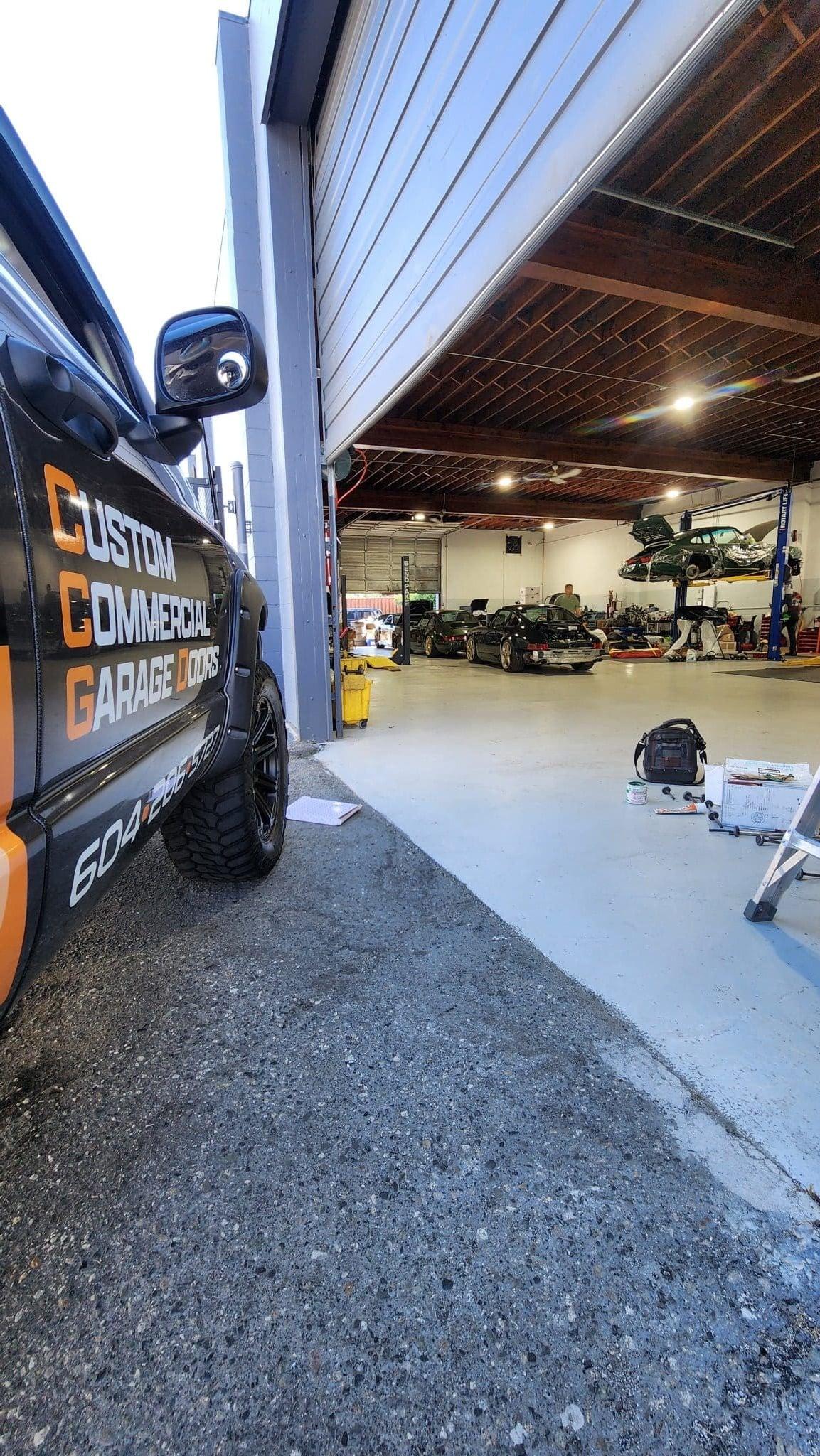
Loading docks and warehouse bays often have a hollow metal pedestrian door cut into the overhead door panel — a “man door.” That door can be an exit if it has panic hardware, swings out, and is not locked from the inside. But the overhead door itself? Still not an exit. The Code does not care that the opening is large enough for a forklift. It cares about the hardware and the swing.
Fire-Rated Openings Are Different
If the wall is a fire separation — common between a warehouse and an office, or between a parkade and a stairwell — the opening must have a fire-rated assembly. A fire-rated overhead door (typically a rolling steel fire door with a fusible link) closes automatically in a fire. It is not an egress door. Its job is to stay closed. If you need egress through a fire separation, you need a separate, listed fire-rated exit door with panic hardware. The two functions do not combine in one product.
High-Lift and Vertical-Lift Tracks Change Nothing
A door that tracks straight up or follows a high-lift path still lifts. It does not swing. The Code does not make an exception for track configuration. The only overhead-type product that qualifies as an exit is a side-folding or side-sliding door listed and labelled as an exit door with panic hardware — rare in BC, and almost never found on a standard loading dock.
What Inspectors Look For
- Panic hardware on every door in the egress path (Article 3.4.6.8)
- Door swings in the direction of egress travel
- No deadbolts, slide bolts, or chains on the egress side
- Clear width of at least 610 mm (24 in.) for the exit door itself
- Illuminated exit sign above the door, not above the overhead door
- The overhead door may stay. It just cannot be counted as an exit.
Common Setups We See in Metro Vancouver
Warehouse with two overhead doors and one man door The man door is the only exit. If the occupant load exceeds 60, you need a second exit — usually another man door on the opposite wall. The overhead doors do not count.
Parkade with overhead vehicle gates Vehicle gates are not exits. Pedestrian exit stairs with fire-rated doors serve the egress requirement. The gate can be open 24/7; it still does not appear on the fire safety plan as an exit.
Retail back-of-house with a single overhead door If the space has an occupant load over 30 (Assembly) or 60 (Mercantile/Industrial), a single overhead door with a cut-in man door gives you one exit. You need a second. Adding panic hardware to the man door is step one. Step two is a second exit path — often a door to the exterior or a rated corridor.
When You Can Use the Overhead Door Opening
During business hours, with the door fully open and the opening unobstructed, people do walk through it. That is occupancy use, not egress design. The moment the door closes — motor failure, power loss, fire alarm release on a rated door — the opening disappears. Code designs for the worst case, not the convenient case.
What to Do Right Now
Walk your building. Count the doors that swing out, have panic bars, and lead outside or to a rated stairwell. That is your exit count. If the number is lower than the Code requires for your occupancy and floor area, you have a deficiency. Fix it with a proper exit door, not a sticker on the overhead door.
Call (604) 206-5727 — Metro Vancouver.