The forklift operator radios in. Panel three is bowed, the track is tweaked, and the door will not seal. You need to know if this is a two-hour fix or a two-day replacement, and you need to know before the shift change. Start with the track. Everything else follows from there.
What to check in the first ten minutes
Walk the opening with a level and a tape measure. Look at the vertical tracks first. A forklift tine hitting the bottom panel transfers force straight up the track. If the track is bowed more than three-sixteenths over eight feet, the door will bind, the rollers will jump, and the opener will shred the top section within a week. Sight down the angle iron. If you see a kink, the track is done. Straightening it with a sledge and a pry bar gets you running today, but the metal has work-hardened. It will bow again under the first wind load.
Check the horizontal track for twist. The rear hangers take the hit when the door is fully open. A twisted horizontal track throws the door into the jamb on the way down. Measure diagonals across the opening. If they are off by more than half an inch, the jamb has shifted. That is structural. No track adjustment fixes a moved jamb.
Panel damage: cosmetic versus structural
A single dented panel on a 24-gauge ribbed door is cosmetic if the ribs are intact and the skin has not cracked at the hinge points. Sand, prime, paint, and move on. But if the impact creased the hinge stile or cracked the end stile where the roller carrier bolts on, that panel is structural. It carries the door weight. Replace it.
On insulated sandwich panels, tap the skin with a screwdriver handle. A hollow sound means the foam core has delaminated. The panel will bow under its own weight inside of six months. Delamination also breaks the thermal break. You will see frost lines on the inside skin by January. Replace the panel.
Sectional doors distribute load through the hinge line. One compromised hinge stile shifts load to the adjacent panels. The top section fails next. I have seen a single forklift hit take out three panels in sequence over a winter because the first one was “good enough.”
Track and hardware decisions
Rollers tell the story. Steel rollers with flat spots mean the door has been jumping the track. Replace all of them on that side, not just the damaged ones. Nylon rollers hide damage better. Pop the stem and check for hairline cracks at the bearing race. If you find one, replace the set.
Hinges bend before they break. A number-two hinge on a sixteen-foot door carries roughly two hundred pounds static. After a strike, the hinge leaf may look straight but the hole is egg-shaped. The bolt walks. The door sags. Replace the hinge.
Bottom brackets take the brunt. The cable anchor point stretches. The bracket twists. If the cable sits crooked in the drum groove, the bracket is bent. Do not straighten it. The cable will fray at the new angle and snap inside of five hundred cycles. A cable failure on a loaded door drops the curtain uncontrolled. That is a write-up, not a repair bill.
Spring and counterbalance assessment
Torsion springs do not care about forklifts — until the door geometry changes. A bowed track adds drag. Drag adds effective weight. The opener works harder. The spring fatigues faster.
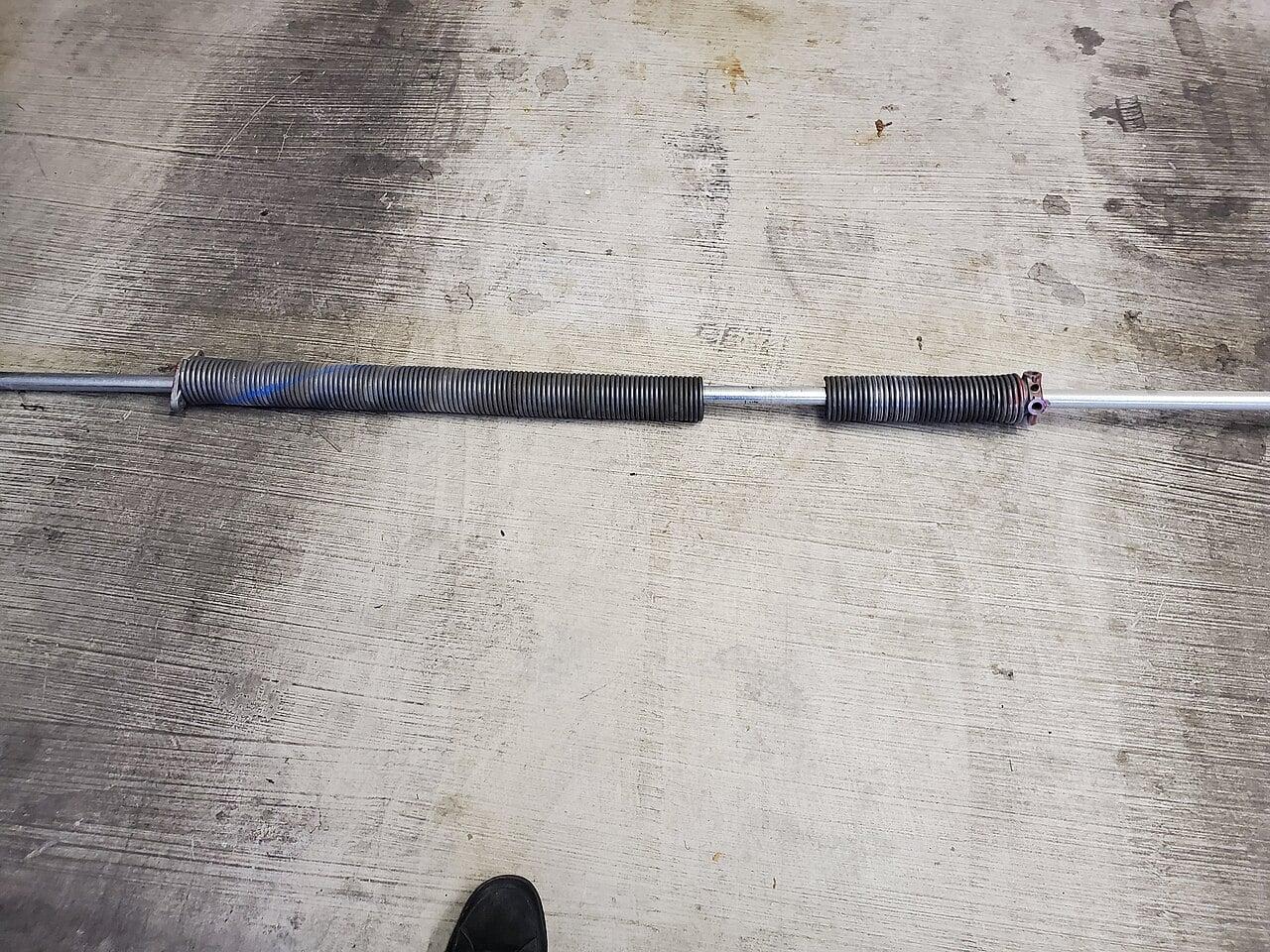
Check the spring stretch. Mark the coils with paint pen, run the door three cycles, measure again. If the stretch increased, the spring is taking more load than rated. On a high-cycle spring rated for twenty-five thousand cycles, a ten percent overload cuts life in half. You will not see the failure. The spring will snap on a cold Monday at 6 a.m. when the steel is brittle.
Extension springs on lighter doors show the problem faster. If the safety cable is slack with the door closed, the spring has stretched permanently. Replace both sides. Mismatched extension springs twist the shaft and crack the center bearing plate.
Operator and safety systems
The photo eyes are the first thing the forklift takes out. The second is the safety edge. Test both with the door at mid-travel. Wave a hand through the beam. The door must reverse instantly. Press the safety edge. Same result. If the operator logic board took a voltage spike from a pinched wire, the reversal delay can hit three seconds. Three seconds at twelve inches per second is three feet of travel. That crushes product, racking, or ankles.
Check the force adjustment. A door with track drag reads as “heavy” to the opener. The technician cranks the force up. Now the safety reversal is calibrated to overcome the drag, not to protect what is in the way. Reset the force after the track is true.
When to call the insurance adjuster
If the jamb is shifted, the header is cracked, or two or more panels need replacement, this is an insurance job. Photograph everything before you touch it. Wide shots showing the forklift position, close shots of each damaged component, a shot of the track plumb reading, a shot of the diagonal measurements. Write the estimate in line items: track, panels, hardware, springs, operator, labor. The adjuster needs line items. “Door repair” gets denied. “Replace left vertical track, two 3×16 insulated panels, four number-three hinges, reset torsion spring balance, recalibrate operator force limits” gets approved.
ICBC and commercial property carriers in the Lower Mainland know our reports. We itemize to their forms. That speeds the cheque.
Prevention that actually works
Bollards. Steel pipe, concrete-filled, four feet high, set three feet off the jamb. Paint them safety yellow. The forklift hits the bollard, not the door. Cost: three hundred dollars installed. Cheapest insurance you will buy.
Floor-mounted guide strips. A six-inch wide steel angle bolted to the slab, flush with the track face. The forklift tire rides up the angle before the mast reaches the door. The operator feels it. They stop. Works best on drive-in doors where the approach is straight.
Laser alignment projected on the floor. A simple diode module mounted on the header, painting a line the forklift operator follows. Cheap, visible, effective in low light. Does not stop a distracted driver, but it stops a drifting one.
Speed bumps twenty feet out. Force the stop before the approach. A forklift at walking speed does one-tenth the damage of a forklift at jogging speed. Physics is not negotiable.
Operator training. The only fix that addresses the root cause. Post the approach path. Mark the stop line. Make the forklift test part of the site orientation. The door company can fix the door. Only the site can fix the driver.
Next step
If the door is running but binding, if the track shows a kink, if the panel skin sounds hollow — stop guessing. Call (604) 206-5727. We dispatch from Richmond, carry common panel sizes and track stock on the trucks, and we write the estimate the adjuster accepts. 24 hours, 7 days a week.