After a shake, the doors on a warehouse, parkade or dock are easy to forget until one won't open. Here is a calm, owner-safe way to check every overhead door in the building, based on the door industry's own maintenance sheets, and the point where you stop and call a technician.
The Province’s PreparedBC guidance puts it plainly: earthquakes are common in B.C., most are too small to feel, and ones strong enough to cause structural damage happen about once per decade. The west coast is the most at-risk area. If your building is in Richmond, Vancouver or anywhere else in the Lower Mainland, checking each overhead door after an earthquake belongs in your post-quake routine.
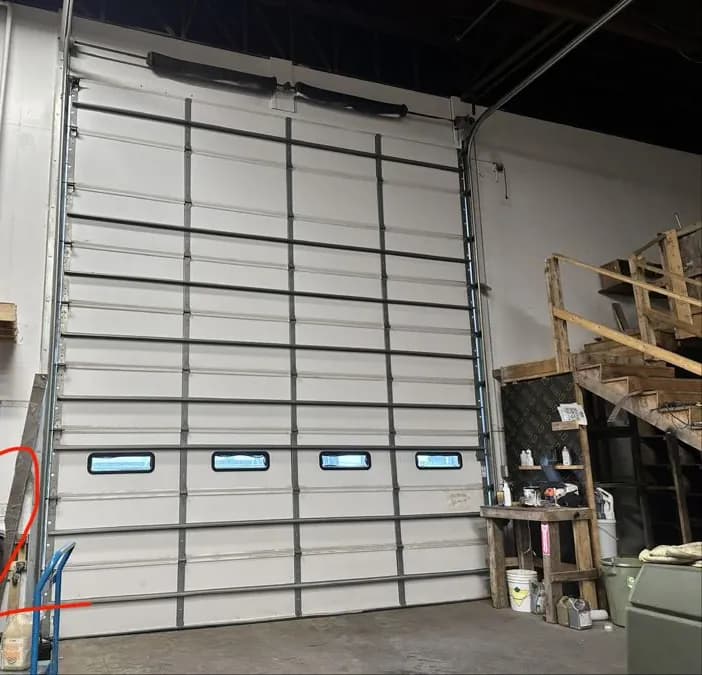
A commercial overhead door is a heavy curtain or set of panels hung from the building on brackets, guides and anchors, balanced by springs that hold a lot of stored energy. Shaking can loosen what holds it up without leaving anything obvious on the floor.
Why the door industry says “inspect now, not at the next service”
The Door & Access Systems Manufacturers Association (DASMA) publishes two maintenance sheets for rolling doors: TDS #269, written for facility managers and building superintendents, and TDS #270, written for building maintenance supervisors. Both carry the same line:
“In addition to the periodic performance evaluation of a rolling door, an event such as high wind, seismic, or flooding should require an immediate evaluation of all door systems in the facility regardless of when the last periodic inspection was performed.”
Two parts of that sentence matter for a property manager. “All door systems” means every door, not just the one somebody complained about. “Regardless of when the last periodic inspection was performed” means a service visit last month does not cover you. DASMA’s normal baseline is inspection and maintenance by a trained door systems technician at least once a year, or per the manufacturer. An earthquake resets that clock.
Before you touch anything: the safety rule
Both DASMA sheets open with the same warning: the counterbalance assembly is under extreme spring tension at all times, and only a trained door systems technician with proper tools should make repairs or adjustments. Severe injury or death can follow from trying it yourself.
So the owner’s job after a quake is to look, listen and write things down. Use the door controls normally, but do not loosen, tighten or adjust anything on the spring side. If something looks wrong, leave the door where it is, keep people clear and call.
Checking an overhead door after an earthquake: the walk-around
This list comes from the items DASMA asks facility staff to look at on rolling doors, ordered for a post-quake check. Most of it also makes sense for sectional doors, which hang from tracks rather than guides. Our door anatomy guide shows where each part sits if you’re not sure what you’re looking at.
1. Look up first: hood, brackets and anchors
- Hood. DASMA says a hood, if fitted, should be properly secured so it will not fall. After shaking, check it before anyone works under it.
- Brackets. They should sit in the vertical plane and square to the wall. A bracket that has rotated or pulled away is a call-out item.
- Masonry anchors. TDS #270 says to call for service when expansion anchors look loose in masonry walls. Look for cracks, dust or gaps around anchor points on block or concrete.
2. Guides or tracks down each side
- TDS #269 asks you to make sure each guide is securely fastened to the jamb and to the wall above it, with fasteners in all slots and holes, properly tightened.
- The guide gap should be the same from top to bottom.
- Bent or damaged guide angles shouldn’t bind the curtain or bottom bar.
On a sectional door, look the same way at the vertical tracks, the hangers that tie the horizontal tracks to the ceiling, and the gap between roller and track along the full run.
3. The spring side: watch, don’t touch
DASMA notes that the tension wheel (charge wheel) and tension shaft should stay still while the door runs. If either turns, stop and call. The sheets also say directly: do not try to adjust the tension wheel.
4. One cycle, with someone watching
If nothing above looks wrong, run the door through one full cycle with a second person watching the whole opening. According to TDS #269, a rolling door in the closed position should rest on the floor or rise slightly. As it nears open, it should move toward the curtain stops. Closing, it should travel freely through the middle of the opening. Watch the operator too: DASMA says it should not sway as the door moves.
5. Manual effort and safety devices
- For doors with hand chains or cranks, TDS #270 says opening force should not exceed 35 lb on a hand chain or 25 lb on a crank. Big departures from that point to a counterbalance problem. Use two hands on a hand chain.
- Test the sensing edge at both ends, as the sheet asks. A quake can knock photo eyes out of line. Our photo eye and safety edge repair page covers what we do when they won’t reset.
What to record for each door
Facilities with a dozen doors lose track fast. A simple table, one row per door, makes the call to a technician quicker and gives you a record for insurance.
| Item | OK / Not OK | Note |
|---|---|---|
| Hood secure | ||
| Brackets square and tight to wall | Photo any gaps or rotation | |
| Anchors in masonry tight, no new cracks | ||
| Guides/tracks fastened, even gap | ||
| Charge wheel and shaft still during travel | ||
| Door rests on floor, travels freely | ||
| Operator steady, no sway | ||
| Hand chain or crank effort normal | ||
| Sensing edge tested at both ends |
Which doors to check first
Nobody publishes a priority order for this, so this is how we would triage a building with several doors:
- Rolling fire doors and fire shutters. They are life-safety equipment and have to close on their own when needed. If shaking has bent a guide, the door may not close fully. Get them checked and consider a drop test. See our fire door drop testing page.
- Doors that secure the building. A parkade door or perimeter door stuck open overnight is a security problem.
- Dock and production doors. These cost you money when they’re down, but a door that is shut and safe can usually wait for daylight.
If the quake also cut the power, our power outage guide explains manual operation. Check the spring side and the guides before you release an operator. A door with a damaged counterbalance can drop.
When it’s an emergency call, and when it can wait
Call right away if a door won’t close and the opening has to be secured, if a hood, bracket or anchor has moved, if a charge wheel or shaft turns during travel, or if a spring or cable looks broken. Those are the cases our 24/7 emergency commercial door repair line is for. An overhead door after an earthquake that is closed, secure and passed every check above can be booked for a normal inspection, which you should still do. DASMA’s line covers every door in the facility.
It also helps to have a written plan before the next event. Our commercial door contingency plan walks through what to set up ahead of time.
Questions property managers ask us
Should every overhead door be inspected after an earthquake, even if it still works?
Yes. DASMA’s rolling door sheets say a seismic event should trigger an immediate evaluation of all door systems in the facility, regardless of when the last periodic inspection was done. A door that still runs can have loosened anchors or bent guides.
Can my maintenance staff adjust the springs if a door feels heavy after a quake?
No. DASMA warns that the counterbalance is under extreme spring tension at all times and that only a trained door systems technician should make repairs or adjustments. Staff can observe and record. They should not touch the tension wheel.
How heavy should a hand-chain rolling door feel?
DASMA TDS #270 says the force to open the door should not exceed 35 lb on a hand chain or 25 lb on a crank. A door that needs much more than that may have a counterbalance problem.
Is a door that closed fine after the earthquake safe to leave until Monday?
If it is closed, secure and passed the walk-around with no loose anchors, moved brackets or turning charge wheel, it can usually wait for a booked inspection. A door that won’t close, or any moved hardware overhead, is a call-now situation.
Do fire doors need anything extra after an earthquake?
Rolling fire doors have to close on their own when needed, so a bent guide or shifted bracket matters more on them. Have them looked at first and consider a drop test to confirm they still close properly.
Book a look at your doors
Call (604) 206-5727 or use the contact page. We answer around the clock for commercial door failures. New commercial clients: 10% off labour on your first service call or repair. Mention NEW10 when booking (one per business, not combinable with maintenance-contract pricing, work booked by Dec 31, 2026).

