Roll Up Garage Doors Repair in Vancouver
Roll-up door repair means fixing roll up garage doors, the rolling steel doors on loading docks, storage buildings and shop bays: the slat curtain, the endlocks, the bottom bar, the guides, the barrel spring, the hood and the operator. We repair them across Vancouver and Metro Vancouver from our shop on River Road in Richmond, and the phone is answered 24/7.
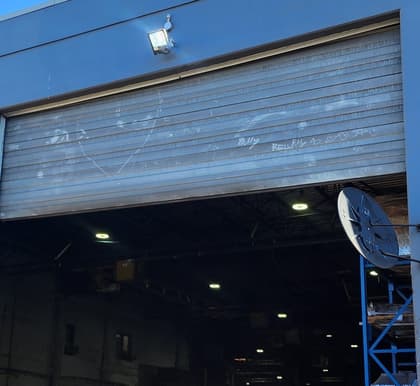
Curtain slats: dents, creases and swapping a slat
The curtain is a stack of interlocking steel slats that coils onto the barrel above the opening. A pallet corner or a forklift tine puts a dent in a slat. A harder hit creases it. A creased slat no longer nests with the slats above and below it, so the curtain goes stiff at that spot and starts to drag as it rolls up.
On most curtains a damaged slat comes out without taking the door down. The endlocks come off one side, the slat slides out sideways, a matching slat slides in, and the endlocks go back on. The catch is the word matching. The new slat has to be the same profile and the same gauge as the rest of the curtain. A near miss will not interlock cleanly, and the curtain binds or gaps at that joint. So the slat gets measured on site before anything is ordered.
Endlocks and windlocks keep the curtain in line
Endlocks are the small pieces fastened to the ends of the slats. They ride inside the guides and stop the slats from sliding sideways. Doors built for wind load carry windlocks as well, which hold the curtain in the guide when wind pushes on it.
When endlocks wear, loosen or break off, the slats start to walk. The curtain edge rubs the back of the guides, the wall angles or the bracket plates. You hear it as a scrape on every cycle. You see it as bright, worn metal along the edge of the curtain. Left alone, the rubbing gets worse until the curtain catches and stops, or a run of slats pulls out of the guide. Endlocks rubbing on a headplate bracket is a service call, not something to run until the weekend.
The bottom bar takes the hits
The bottom bar runs along the leading edge of the curtain. It carries the bottom seal and, on most powered doors, a sensing edge that tells the operator to stop and reverse when it touches something. It is also the first part a trailer, a pallet jack or a forklift reaches.
A bent bottom bar will not sit flat on the floor, so the seal gaps and water and grit come in under the door. A crushed or torn sensing edge leaves the operator without its safety input. Under UL 325 the close button then has to be held down for the door to close. A badly bent bar is usually replaced rather than straightened, because the seal and the sensing edge both need a straight bar to sit on. A new sensing edge gets tested at both ends before the door goes back in service.
Guides, wall angles and the stops at the top
Each guide is built from a wall angle bolted to the jamb and a guide angle that forms the channel the curtain runs in. The gap between the guide angles has to be even from top to bottom. Too tight and the curtain binds. Too loose and the endlocks have room to wander.
Guides take vehicle hits at bumper height and at mast height. A guide that looks straight from the floor can still be twisted enough to catch endlocks on every cycle, and that is how a small dent turns into a torn curtain. Bent guide angles get straightened or replaced, and the anchors into the jamb get checked, especially in masonry where expansion anchors can work loose.
At the top of each guide sits a stop. Its job is to stop the bottom bar at full open. With a stop missing, the bottom bar can be pulled up past the guides and into the coil.
Barrel spring tension and what normal feels like
The barrel is the pipe above the opening that the curtain wraps onto. The counterbalance spring lives inside it, and a tension wheel, also called a charge wheel, sits at one bracket. The whole assembly is under heavy spring tension all the time, whether the door is open, closed or broken.
A rolling door does not balance evenly the way a sectional does. It balances near the top and near the bottom and takes more effort through the middle of its travel. That is how the design works, so a door that feels heavier halfway up is normal. What is not normal is a hand chain that needs more than about 35 lb of pull, a crank that needs more than about 25 lb, or a tension wheel that turns while the door runs. Any of those points to a counterbalance problem. The theory is on our rolling steel door spring tension page, and the hardware inside the barrel is on barrel spring assembly.
Hood, chain hoist and crank on roll up garage doors
The hood is the sheet metal cover over the coil. It keeps debris off the spring and the curtain, and it has to be fastened so it cannot drop. A hood knocked inward rubs the curtain on every turn.
Many roll up garage doors have a hand chain hoist or a crank for manual operation, and powered hoist operators carry an emergency chain for power cuts. The chain should feed smoothly through the hoist without jumping. If the chain jumps or the crank binds, the cause can be the hoist gearing, a curtain dragging in a guide, or the spring. Light self-storage doors use a ratchet tensioner instead of a tension wheel, and that hardware is covered on our rolling sheet door spring tensioner page.
The operator on a rolling door
Roll up garage doors are driven by side-mounted operators, jackshaft or hoist types, bolted beside the bracket and coupled to the barrel by a sprocket and roller chain. A ceiling trolley opener cannot drive one.
The operator’s limits are set so the bottom bar does not jam tight against the guide stops at the top and the curtain does not sag on the floor when closed. Limits that drift let the bottom bar drive into the stops on every cycle, which bends the bar and shocks the drive. On the drive side the checks are mechanical. Keystock seated in the keyway. Sprockets lined up and set screws tight. Roller chain not stretched or kinked. Gear teeth whole. The chain and gears get cleaned and lubricated. An operator that sounds like it is straining is often fighting the door rather than failing itself, which is why the door gets checked by hand before anyone condemns the motor.
Roll-up door repair or a new curtain?
Most roll-up door repair on a curtain is slat work, but there is a point where patching costs more than it saves. Four things decide it. How many slats are creased, and whether the creases run across most of the curtain. Whether the slat profile and gauge can still be matched. Whether endlocks have torn off along a run of slats, which happens when a door keeps running with a bent guide. And whether the curtain was pulled out of the guides, which bends the interlocking edge of every slat that came out.
A few dented slats on an otherwise sound curtain is a repair. Creases all the way up, an obsolete profile or a long run of missing endlocks means a new curtain, because slats that are all a little bent keep jamming. A new curtain changes the weight on the barrel, so the spring tension gets checked and set to suit it. When both options are realistic, you get both priced. If the opening itself is being rethought, our roll-up vs sectional doors page compares the two.
What wears roll up doors out in warehouses, docks and storage
Vehicle and forklift strikes on the guides and the bottom bar are the obvious cause. Running the door after a strike is the next. A curtain dragging through a bent guide tears endlocks off a few at a time until a whole edge is loose. Operator limits that drift let the bottom bar slam into the stops. Closing the door onto a pallet or a bin left in the opening crushes the sensing edge and bends the bar. A dry drive chain wears its sprockets and starts to jump teeth.
Then there is the coast. Near the Fraser River and Burrard Inlet, salt air pits spring wire, and fatigue cracks start at the pits, which shortens spring life. Doors close to the water last longer when they stay closed where the operation allows it. After high wind, an earthquake or a flood, every door in the building should be looked at right away, no matter when it was last inspected.
What a building manager can check, and what to leave alone
Some checks need no tools. On electric doors, once a quarter, close the door with the operator, switch to manual, and try to lift the curtain a foot or two. If that takes a lot of force, book a service call. Look up the guides for dents, a gap that changes width, or a missing stop at the top. Keep pallets, bins and stored stock out of the opening so the curtain has nothing to close on.
Leave the tension wheel, the barrel, the spring and the headplate brackets alone. The counterbalance is under heavy tension at all times, and only a trained door technician should adjust or repair it. That includes adding a turn because the door feels heavy. DASMA recommends a trained technician inspect a rolling door at least once a year, or as often as the manufacturer says.
How a roll-up door repair visit runs
The operator gets locked out first so nobody can cycle the door while a tech is in the opening. The spring tension stays on unless the repair needs it off. The inspection runs top to bottom: guides and stops, curtain and endlocks, bottom bar and sensing edge, the barrel and its brackets, the hood, then the operator limits and drive. A roll-up door repair can turn up a second problem behind the first, a bent guide behind the torn endlocks or drifting limits behind the bent bottom bar, and you hear about both.
You get a price before work starts. The phone is answered 24/7 and the call goes to the nearest technician carrying the right parts. Fire-rated rolling doors follow different rules, with fusible links and drop tests, and they are covered on rolling fire doors and fire shutters. Sectional doors are on commercial overhead door repair, and the taller plant doors are on industrial garage door repair.
Frequently Asked Questions
Can one dented slat be replaced on a roll-up door?
Usually, yes. The endlocks come off one side, the damaged slat slides out sideways and a matching slat slides in. It has to be the same profile and gauge as the rest of the curtain.
Why is my roll-up door heavier halfway up than at the top or bottom?
Rolling doors are built that way. The coil changes size as it winds, so the door balances near the top and near the bottom and takes more effort through the middle. On its own that is not a sign of a bad spring.
How hard should a roll-up door be to open with the hand chain?
DASMA’s guideline is no more than 35 lb of pull on a hand chain or 25 lb on a crank. A lot more than that points to a counterbalance problem, a dragging curtain or a hoist fault, and it needs a service call.
Is it safe to keep running a roll-up door with a bent guide?
No. A bent guide catches the endlocks on every cycle and tears them off a few at a time. A guide repair left too long becomes a curtain repair. Lock out the operator and book the guide.
Why will my roll-up door only close while I hold the button?
The operator has lost its safety input, often a damaged sensing edge on the bottom bar or photo eyes knocked out of line. Under UL 325 a door without working sensing devices may only close under constant pressure. Get the device repaired, not bypassed.
How often should a warehouse roll-up door be inspected?
DASMA recommends a trained technician inspect a rolling door at least once a year, or as the manufacturer says. Every door should also be looked at after high wind, an earthquake or flooding.
A roll-up door stuck open is a security problem, and one stuck shut stops the dock. Call (604) 206-5727 any hour, tell us what the door is doing, and send a photo of the curtain and the bracket if you can.