Commercial Doors Vancouver
This page sorts the commercial doors Vancouver buildings run on by type: insulated sectionals, full-view aluminum, rolling steel, grilles, high-speed, fire doors, dock doors and cold storage doors. Each section says how to spot the door at the opening and where it fits, then links the page that covers it in depth.
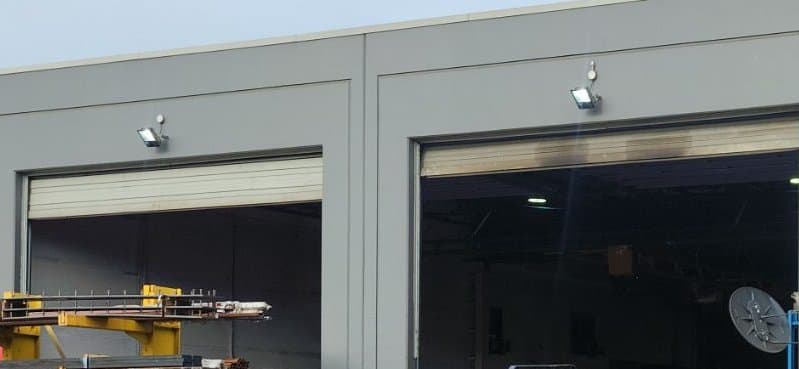
Insulated steel sectional overhead doors
A sectional door is the one most people picture. Hinged steel sections ride on rollers in a track that turns and runs back under the ceiling, and torsion springs on a shaft above the header carry the weight. On heated or cooled buildings the sections are foam-filled.
The sectional needs room. Headroom above the opening for the springs and the turn of the track, and side room beside the opening for the vertical track. Where the ceiling is busy with cranes or racking, high lift or vertical lift track sends the door up the wall instead. In return you get a door that insulates and seals well, and a bottom section that can be replaced on its own when a truck finds it.
Lines on this site include the full Amarr commercial doors range, Raynor ThermaSeal TM200 and TM300, and the Hörmann 450U. The wider picture is on insulated commercial garage doors.
Full-view aluminum doors
A full-view door is built from aluminum-framed sections glazed with glass or polycarbonate, so you can see through it when it is shut. It still runs in a sectional track with springs above the header. You find them where daylight or a view matters more than anything else: restaurant patios, breweries, car showrooms, fire halls and retail frontages that open to the street.
The trade-off is plain. Glass and aluminum let light in and look good from the sidewalk, but they will not hold heat like a foam-filled steel section, and glass is less forgiving of a careless bumper than steel. Polycarbonate glazing is tougher than glass where knocks are likely.
The full-view aluminum doors page covers where they work and where they do not. Model detail is on Raynor AlumaView AV200, and the Hörmann 750A is the other full-view line on this site.
Rolling steel roll-up doors
A rolling steel door has no sections and no ceiling track. A curtain of interlocking steel slats coils onto a barrel above the opening, under a hood, and runs down in guides on each side. The counterbalance spring sits inside the barrel. Smaller doors run on a hand chain or a crank, and bigger ones on a side-mounted operator.
Because nothing runs back into the building, the ceiling stays clear for lights, sprinklers, cranes and racking. Side room is small. The coil and hood do need room above the opening, so check that before you choose. Most curtains are plain steel, which suits shop bays, waste rooms, warehouses and storage, but not a heated space that needs insulation.
The Raynor DuraCoil is the rolling service door line on this site. Slats, endlocks, guides and barrel tension are covered on roll-up door repair.
Security grilles and counter shutters
A security grille locks an opening without closing it off. A rolling grille coils like a rolling steel door but the curtain is rods and links, so you can see through it and air moves. Side-folding grilles stack to one side instead, where there is no room for a coil above. You see them on mall storefronts, parkade entrances and shops that want the display lit after hours.
Counter shutters are the small version, over a service window, a pharmacy counter or a concession stand. Some are fire-rated, and those carry the same testing duty as a rolling fire door.
The trade-off is weather. A grille stops people, not rain or wind, so it belongs inside a building or behind an exterior door. The security grilles and counter shutters page goes through rolling and side-folding styles, and Raynor DuraGrille is the grille line here.
High-speed doors
A high-speed door uses a fabric or rubber curtain that opens and closes far faster than a standard door and is built for very high cycle counts. They earn their place on interior openings with steady forklift traffic, on cold rooms where every second open costs refrigeration, and in food plants where one area has to stay separate from the next.
The curtain is soft. A forklift that clips it does less damage than it would to a steel door, but a soft curtain is also not a security door, so a high-speed door usually works behind or beside a conventional door on the building’s outside wall. Controls matter as much as the door: motion sensors, loops and interlocks decide whether it opens on time or makes drivers wait.
The high-speed industrial doors page covers when the extra cost pays back. Manaras Rapido is the high-speed operator family on this site.
Rolling fire doors and fire shutters
A rolling fire door looks like a heavy rolling steel door, but it is a labelled fire-rated assembly that sits open and closes on its own when a fusible link melts or the fire alarm signals. The fire label is on the guide, the hood or the bracket. Fire shutters do the same job over smaller openings.
These are not optional where a wall is fire-rated, and they come with paperwork. NFPA 80 requires an inspection and two drop tests every year by a trained rolling steel fire door technician, and that applies to doors that never move day to day. Anything hung off the assembly, conduit or ceiling grid included, has to come off it.
How they close and what an inspector looks for is on rolling fire doors and fire shutters. Raynor FireCoil is the fire-rated rolling door line on this site.
Loading dock doors and the equipment around them
A dock door is usually a sectional at truck height, and it never works alone. Around it sit a dock seal or a dock shelter, a leveler that bridges the gap to the trailer bed, bumpers that set the standoff and take the impact, and often a vehicle restraint that holds the trailer at the dock with traffic lights inside and out.
Seals and shelters suit different fleets. A foam seal presses against the trailer and gives the tightest seal when trailer sizes are consistent. A shelter uses fabric curtains and handles a wider mix of trailers. Levelers come mechanical, hydraulic or air-powered. Specify the door and the dock position together, because a worn bumper or a sagging leveler ends up as damage to the door.
Door types and failures are on loading dock doors, and the equipment side is on dock levelers, seals and shelters.
Cold storage and freezer doors
A cold storage door is a heavily insulated door with tight perimeter seals, built to stop the opening from becoming the biggest heat leak in the room. On the outside wall that is usually an insulated sectional. On interior openings between a cold room and a warmer area, a high-speed door is common, because the shorter the door stays open the less cold escapes and the less frost builds up.
Watch the seals and the floor. A worn bottom seal lets warm, wet air in and frost forms around the opening. Ice frozen to the slab can make a door reverse on close in a cold snap, and running the operator against it does damage.
The cold storage doors page covers panel construction, seals and when to pair a high-speed door with an insulated one.
Which commercial doors Vancouver buildings need, by building type
Picking commercial doors Vancouver buildings can live with starts with the building, not the catalogue. A strata parkade entrance cycles all day and sits under homes, so a quiet operator rated for the duty matters as much as the door, and a grille may suit where airflow is needed. A warehouse dock needs sectionals at truck height and a dock position specified with them. An auto shop bay with a vehicle lift often needs the ceiling clear, which points to a rolling door or high lift track. A restaurant or showroom frontage usually wants full-view aluminum. A food plant may need an insulated door on the outside wall and a high-speed door on the interior traffic opening. Self-storage aisles suit light rolling doors.
When the choice is between rolling steel and a sectional for the same opening, the roll-up vs sectional doors page sets out headroom, impact, insulation and maintenance side by side.
How to identify the door you already have
Before you call about commercial doors in Vancouver, a few photos save a site visit. Stand back and take one of the whole opening with the door closed. Then take one of what is above the opening: a coil under a hood means a rolling door, a spring shaft and track means a sectional. If there is an operator, photograph its nameplate, because the model and voltage decide which parts fit.
Look for a manufacturer label or tag on the door, the guides, the hood or the operator. On a rolling door, check the guide, hood and bracket for a fire label, because a labelled door carries the annual testing duty. Measure the opening width and height. With that in hand we can tell you which page and which part you need, often before anyone drives out.
Supply, install and repair from one commercial company
Custom Commercial Garage Doors is commercial only, based at 7080 River Rd in Richmond, and we supply, install and repair commercial doors Vancouver wide, across Richmond, Burnaby, Surrey, Delta, New Westminster, Coquitlam, Langley and the North Shore. We supply and install the full Amarr commercial line, work with Raynor, LiftMaster and Manaras, and are Richmond’s only Hörmann-certified commercial garage door company. The operators that drive these doors are on commercial door operators, and the full brand list is on brands we service.
For a new opening or a replacement, the steps from site measure to handover are on commercial garage door installation. For a door that is down, the repair side is on commercial garage door repair in Vancouver. The phone is answered 24/7.
Frequently Asked Questions
Which commercial door suits a warehouse bay with a low or busy ceiling?
A rolling steel door, because it coils above the opening and nothing runs back under the ceiling. If the building needs an insulated door, a sectional on high lift or vertical lift track can also keep the ceiling clear, as long as the wall above the opening has room for it.
What is the difference between a rolling grille and a rolling steel door?
Both coil above the opening. A rolling steel door has a solid slat curtain that closes the opening to weather. A rolling grille has an open curtain of rods and links that you can see and breathe through, so it secures a storefront or parkade without shutting it off.
How can I tell if a rolling door in my building is fire-rated?
Look for a fire label on the guide, the hood or the bracket. A labelled rolling fire door has to be inspected and drop-tested twice every year under NFPA 80, even if it never closes day to day.
Should a cold storage opening get a high-speed door or an insulated sectional?
Often both. An insulated sectional closes the outside wall, and a high-speed door on interior traffic openings keeps the time open short so less cold escapes. The right mix depends on how many trips go through each opening.
Can one company supply, install and repair every commercial door in a building?
For commercial and industrial doors, yes. We supply, install and repair sectional, rolling, grille, high-speed, fire-rated, dock and cold storage doors and their operators. We do not work on residential garage doors.
What should I send before asking for a quote on a commercial door?
A photo of the whole opening, a photo of what is above it, the operator nameplate if there is one, any label on the door, and the opening width and height. That is usually enough to tell which door you have and what it needs.
If you are planning a new opening or have a door down, call (604) 206-5727 and tell us what the building is and what the door has to do.